
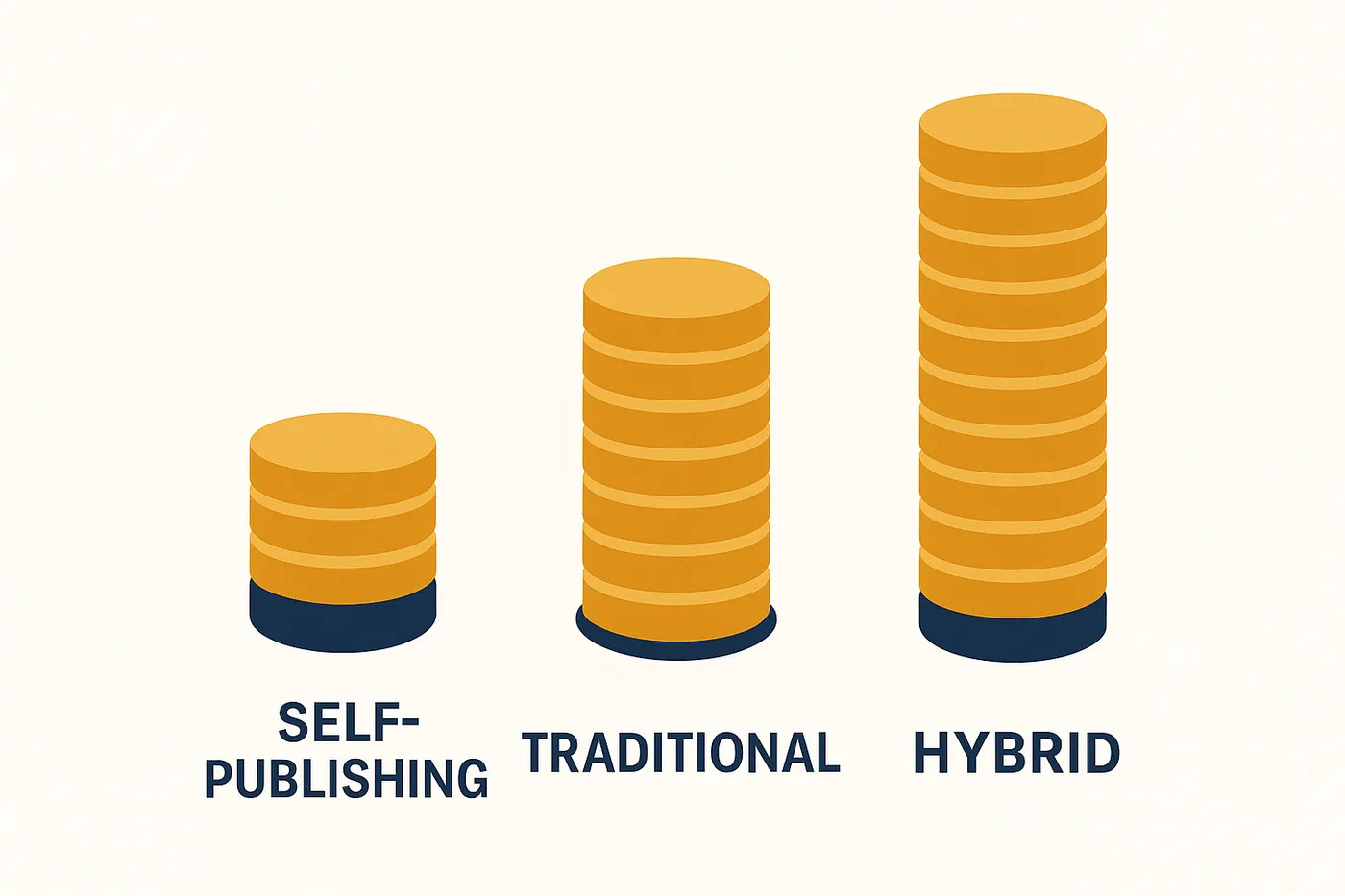
Short answer: partnership (hybrid) publishing costs more upfront than a do-it-yourself upload to Amazon and less than the years a traditional deal can take to say yes, if it ever says yes at all. The real number depends on scope: how much writing help you need, how many editing passes, cover and interior design, and the size of the launch campaign. [NEEDS CONFIRMATION: published price tiers] will hold the exact figures once they’re finalized on this page.
This guide walks through what actually moves that number, what each stage of a real partnership publishing project includes, how it compares to the two alternatives, and the specific questions worth asking before you commit a five-figure decision to anyone, including us.
Key takeaways
- Self-publishing looks cheapest in cash, but the hidden cost is your own time.
- Traditional publishing charges nothing upfront and bills you instead in time, rights, and royalties.
- A real partnership publisher itemizes every piece of the price, and payment plans exist so it isn't one lump sum.
- The price moves with scope: how much writing help you need, how many editing passes, and how big the launch is.
- A book done wrong costs the same money twice: once to make it, again to fix it.
What actually drives the price up or down?
Two authors can pay very different amounts for the same kind of book, and it usually comes down to five factors. Knowing them before you get on a call means you can ask sharper questions and spot a vague quote faster.
How much writing help you actually need. An author who already has a rough draft, a set of talks, or years of blog posts to pull from needs less structural work than someone starting from a blank page. Full ghostwriting, where a writer builds the entire manuscript from structured interviews, costs more than developmental editing on a draft you already wrote yourself.
How many editing passes the book gets. A single proofread is not the same job as developmental editing, followed by line editing, followed by a copy edit. Each pass catches a different kind of problem: structure, then sentence-level clarity, then grammar and consistency. More passes cost more, and skipping them shows up later in reviews.
Design complexity. A straightforward nonfiction cover and simple interior formatting cost less than a heavily illustrated book, a book with charts and diagrams throughout, or a design that needs multiple rounds of revision because the first concept didn’t land.
Distribution and format count. Print, ebook, and audiobook are three separate production jobs, not one job in three file formats. Wanting all three from day one costs more than launching with print and ebook and adding audio later.
How big the launch campaign is. A modest launch plan and a full campaign with a publicist, media outreach, and a multi-week promotional sequence are priced very differently, because they require very different amounts of work.
None of this is unique to any one publisher. It’s simply what goes into producing a book that’s actually ready to compete on a real shelf, and it’s why “how much does it cost” rarely has a single right answer until someone knows your specific starting point.
Two hypothetical authors, two different starting points
These aren’t real clients. They’re illustrations of how the same five factors above actually move a quote, since the difference is usually about starting point and scope, not negotiating skill.
Author A has been giving the same keynote for three years and already has a slide deck, a dozen blog posts, and a rough outline in her head. She wants print and ebook, a standard launch, and two rounds of editing. Her project needs less manuscript development, because most of the raw material already exists. It mostly needs structure, editing, and design.
Author B has a career’s worth of expertise but has never written anything longer than an email. He wants full ghostwriting from structured interviews, print, ebook, and audiobook from day one, and a full launch campaign with media outreach. His project needs more of every stage: more extraction sessions, more design formats, more launch work.
Same publisher, same process, genuinely different scope, which is exactly why an honest quote depends on a real conversation about where you’re starting from, not a single number that applies to everyone.
What’s actually included in that price?
A real partnership publisher itemizes what you’re buying, the same way a contractor itemizes a renovation. That usually breaks into a handful of real, separately priced pieces:
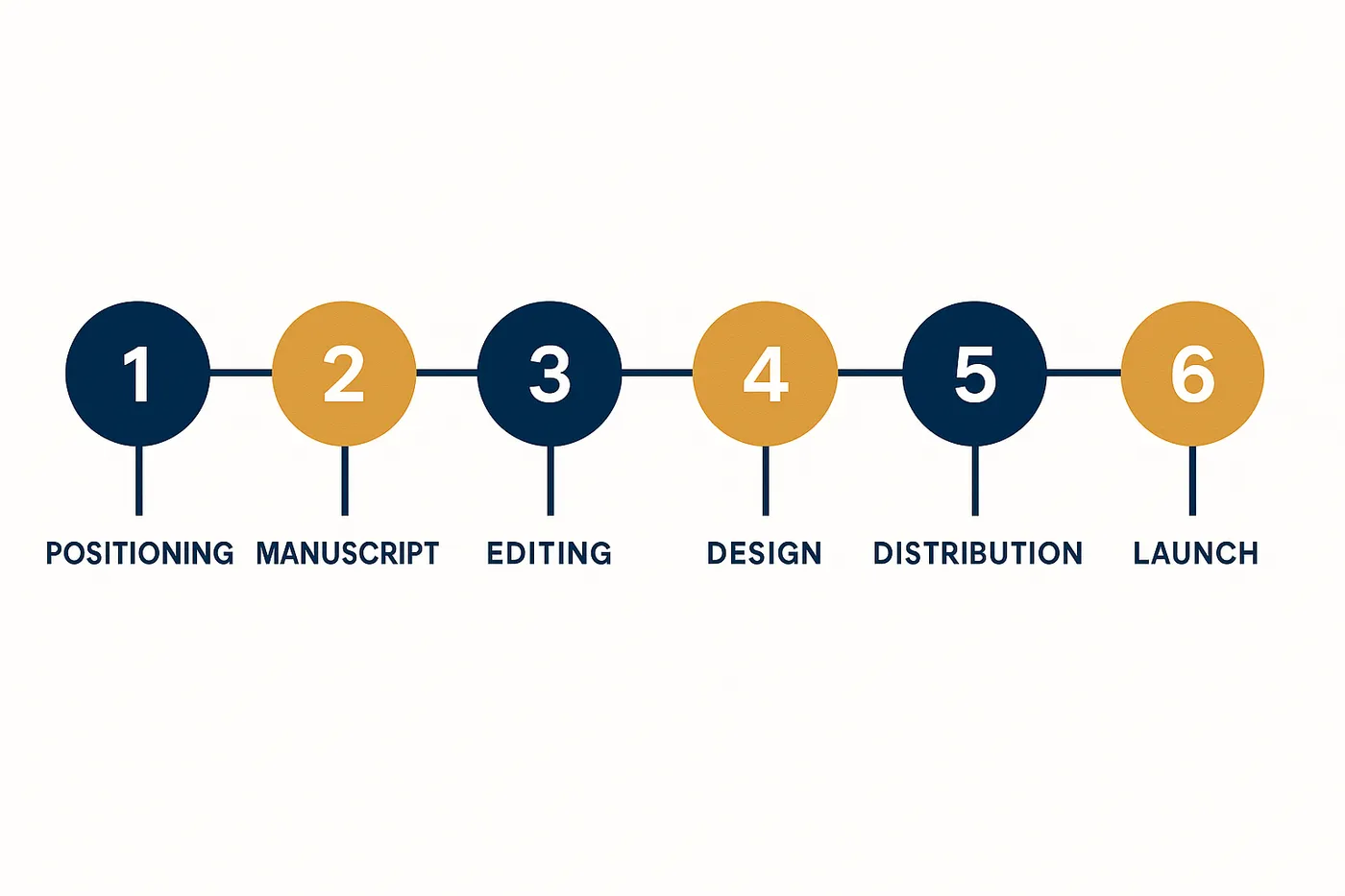
Each of those six stages is its own deliverable: positioning decides the one reader, the one promise, and the shelf the book competes on, before a word is drafted. Manuscript development is structured extraction sessions or full ghostwriting, depending on how much you’re starting with. Editing means developmental, line, and copy passes, each catching a different layer of problem. Design covers a cover tested against the genre shelf, plus print and digital interior formatting. Distribution means getting the book listed correctly everywhere books are sold, under the right categories and metadata. Launch is a release sequence, advance copies, and a plan for the weeks after launch day, not just launch day itself.
Vagueness is where trust goes to die for this audience, and for good reason. If a company can’t tell you what you’re paying for, ask why. A [NEEDS CONFIRMATION: published price tiers] breakdown belongs on the pricing page, in writing, before you ever get on a call.
Why does self-publishing look cheaper?
It is cheaper in cash, and it’s honest to say so. Self-publishing platforms don’t charge a listing fee, so you can format a manuscript yourself, buy a template cover, and upload it to a retailer for a few hundred dollars in out-of-pocket costs.
The hidden cost is time, and time is the one thing most of our authors say they don’t have. Here’s what that few hundred dollars usually doesn’t include, and what you’d need to either learn or hire out separately:
- A developmental edit. Without one, structural problems that a reader would notice usually go uncaught until after the book is live.
- A cover that’s tested against the genre shelf, not just one that looks fine in isolation. A template cover rarely competes with a professionally designed one sitting next to it on a retail page.
- Interior formatting that looks intentional in both print and digital editions, not just technically functional.
- A launch plan, which is a different skill from writing the book and usually the single most skipped piece of a DIY launch.
- The positioning work that decides who the book is actually for before a word gets written, which is easy to skip and expensive to fix later.
Doing all of this yourself, for the first time, on top of a full career, is its own kind of expensive. It’s just priced in hours instead of dollars, and those hours come from evenings and weekends that don’t return. Some authors are the right fit for the self-publishing path, particularly if they already have design or editing skills, or a smaller, well-defined audience that doesn’t need a full launch campaign. Most of the people who come to us tried it first and ran out of hours before they ran out of manuscript.
Why does traditional publishing look free, and what does it actually cost you?
Traditional publishing doesn’t charge you upfront, which is exactly why it feels free. It charges you in three other currencies instead: time, rights, and royalties.
Time. The traditional path usually starts with querying literary agents, since most major publishers only accept agented submissions. That means writing a full manuscript or a detailed proposal on spec, with no guarantee anyone says yes, then querying dozens of agents if the first round goes quiet. If an agent does sign you, the next step is pitching publishers, which is its own round of rejection and waiting. Traditional houses reject the overwhelming majority of submissions at every stage of that funnel. If a publisher does say yes, acquisition, editing, and a production schedule set by the publisher, not you, can easily run 12 to 24 months between that yes and a finished book on a shelf, sometimes longer.
Rights. Signing with a traditional publisher typically means signing away most of the rights to your own book: how it’s distributed, in what formats, in what territories, and for how long. Getting those rights back later, if you can at all, is its own negotiation.
Royalties. Trade publishing royalty rates are public knowledge in the industry: authors typically keep a smaller share of each sale than they expect going in, since the publisher’s advance, printing, distribution, and overhead all get paid before the author’s royalty percentage applies.
None of this makes traditional publishing a scam. It’s a different trade: you give up speed, rights, and a larger royalty share in exchange for a publisher’s imprint, distribution relationships, and (sometimes) an advance. That trade makes sense for some books and some authors. It’s rarely the right trade for a working professional who wants a book that opens doors, clients, and speaking invitations in the next year, not the next three, and who doesn’t want to spend that time waiting for permission from a stranger to publish their own expertise.
Questions to ask before you sign with anyone
Whether you’re talking to us or anyone else, these are the questions that separate a real answer from a sales pitch:
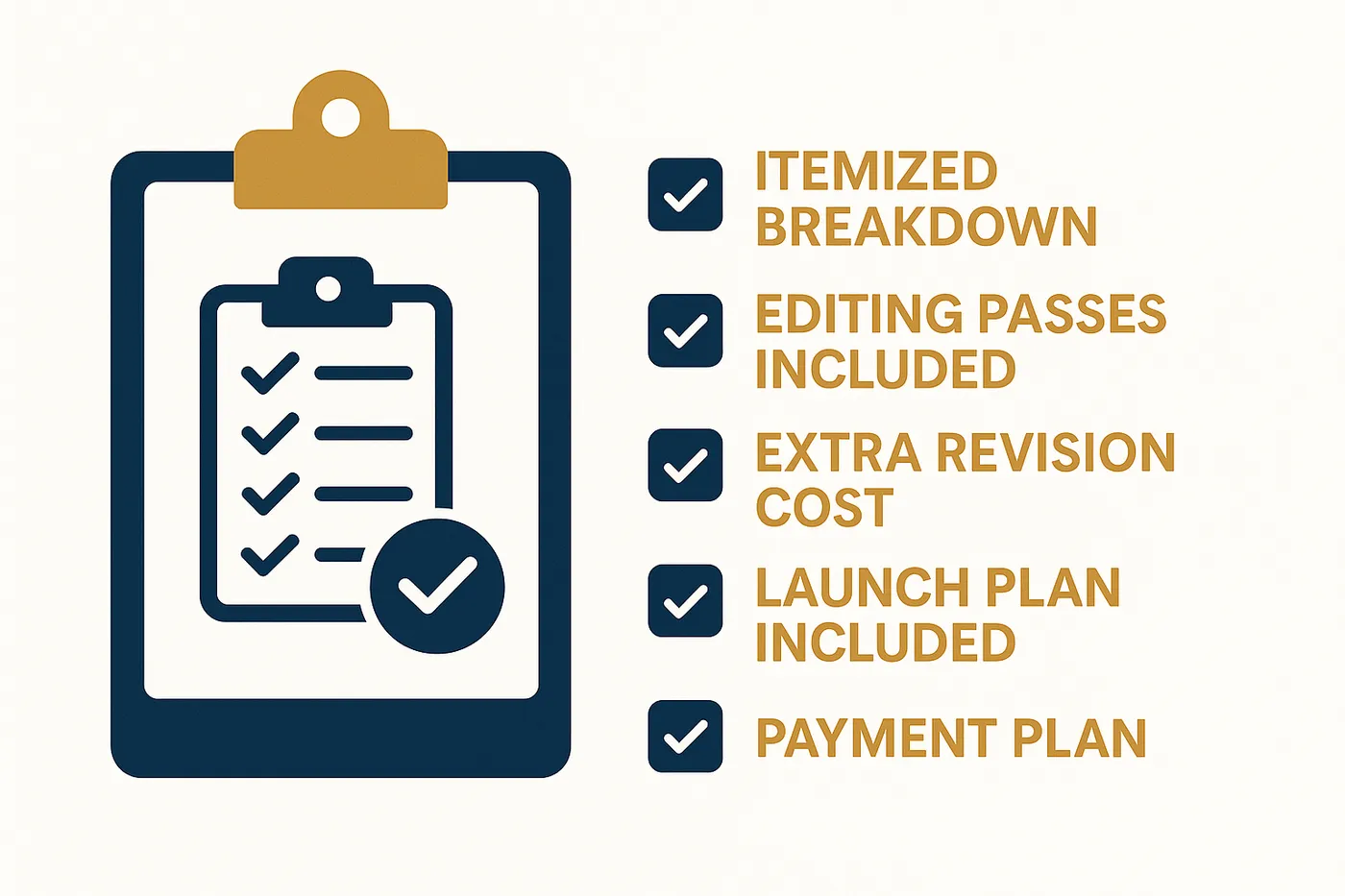
Ask whether you can see the itemized breakdown in writing, exactly how many editing passes are included, what happens if you need more revisions than the package covers, whether a launch plan is included or the deliverable stops at “in print,” whether payment plans are available, and whether they can show you a sample edit. If the answer to any of these is vague, or they can’t produce one, that’s the answer.
If a company can’t answer these clearly and in writing, that’s worth treating as information, not an oversight.
How professionals typically think about budgeting for this
Most of the authors we work with think about this the same way they’d think about any other five-figure business investment, not a personal indulgence. A few practical angles that come up on almost every strategy call:
It’s often treated as a business expense. Many professionals use the book for lead generation, speaking, or authority building tied directly to their practice or company. Whether an expense like this is deductible for your specific situation is a question for your own accountant or tax advisor, not something we can answer generically here, but it’s worth asking rather than assuming either way.
Payment plans exist for exactly this reason. Spreading the investment across the same months the book is actually being written and produced means the payment schedule tracks the work schedule, instead of asking for one lump sum before anything has happened.
The comparison that actually matters isn’t “book cost versus zero.” It’s book cost versus what a professionally produced credential is worth to your specific business over the years you’ll use it, compared to the alternative of continuing without one, or spending a comparable amount on a different form of marketing or credibility building that may or may not work as well.
None of this replaces running your own numbers for your own situation. It’s simply the frame most authors land on once they get past the sticker-shock reaction to a five-figure number and start comparing it to what else that kind of investment could or couldn’t do for them.
Is this the right investment for you right now?
Cost questions are really readiness questions in disguise. A few signs the investment tends to make sense, and a few signs it might be worth waiting:
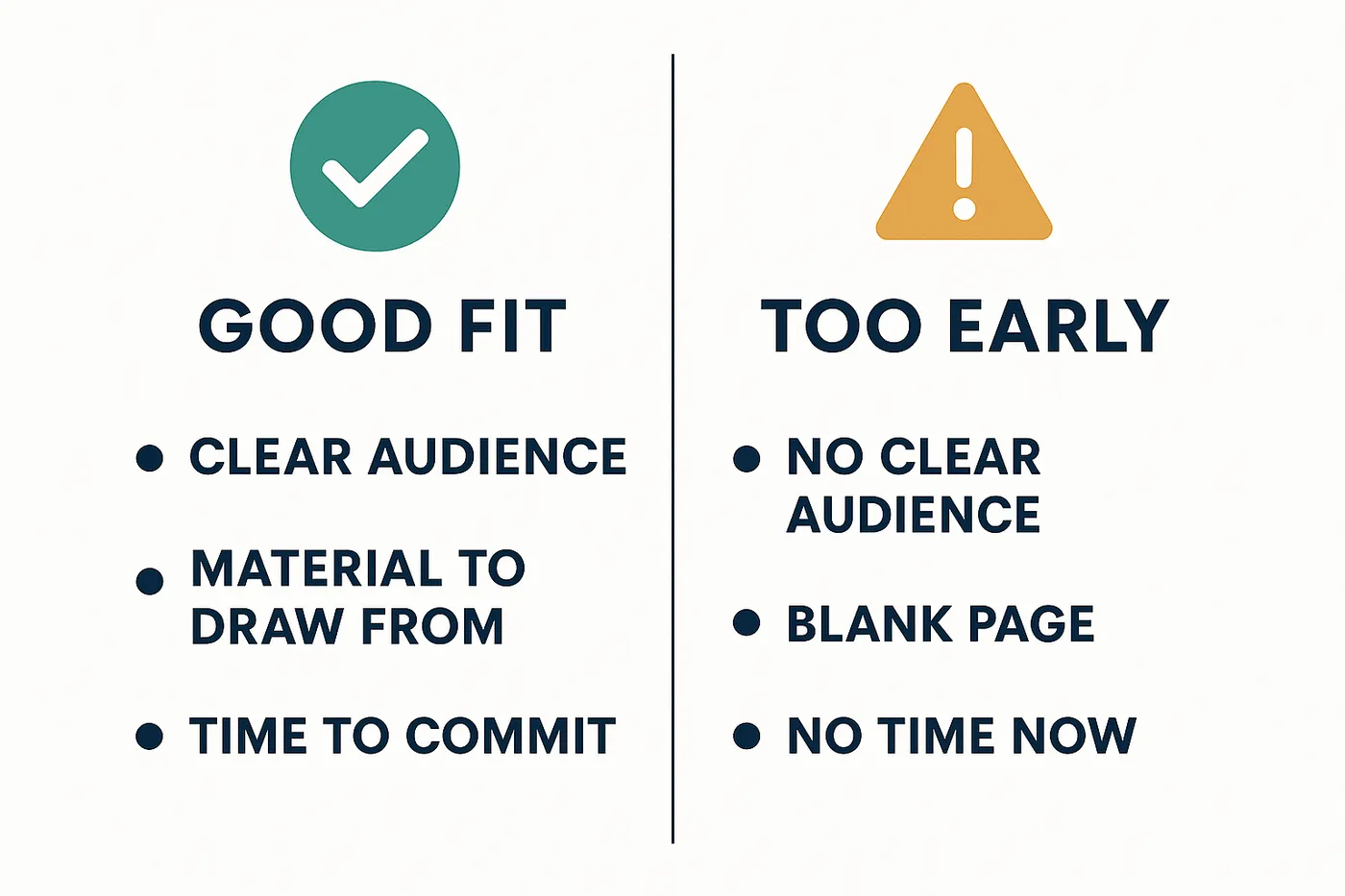
A good fit usually means you have a clear audience of clients, patients, or an industry who’d read this book, you already use speaking, sales calls, or media to grow your business, you have material to draw from (talks, notes, years of client conversations), and you can commit real time to structured sessions over several months. It might be too early if you’re not yet sure who the book is for, you’re starting from a completely blank page with no material at all, or your schedule genuinely has no room for the process right now.
None of this is a hard rule. It’s a gut check worth running honestly before a five-figure decision, and it’s exactly the kind of thing a real strategy call should help you work through, not paper over to close the deal.
Does the type of book you’re writing change the price?
Somewhat, though less than most authors expect. What actually moves the number is less “which category” and more “how much structural and narrative work that category typically needs”:
- Business and leadership books usually need a clear framework: a named method, a sequence of ideas that build on each other, and concrete examples from your own work. That framework-building is part of the positioning and manuscript stages.
- Memoirs need less framework-building and more narrative craft: pacing, scene-setting, and shaping a true story into something a reader wants to keep turning pages for, which is a different (not necessarily cheaper or more expensive) kind of editorial work.
- Self-help and how-to books typically need the most actionable structure: clear steps, exercises, and a reader who can actually apply what they read, which shapes both the manuscript stage and how the interior is designed.
- Health and wellness books sometimes carry an added review step, checking specific claims and recommendations for accuracy, which can add time depending on the subject matter.
The category matters less than being honest about which of these your specific book actually is, since a business book written like a memoir (or the reverse) tends to underperform regardless of how much anyone spent on it.
Are there payment plans?
Yes. A five-figure decision shouldn’t have to clear in one transaction, and it doesn’t have to here. Payment plans are standard, and the specifics depend on the package you choose and, in some cases, which stage of the process you’re paying for. Some authors prefer to pay stage by stage: positioning and manuscript first, then design, distribution, and launch once the book itself exists. Ask for the plan in writing before you commit to anything, from us or from anyone else you’re considering.
Is it worth it?
That depends on what the book is for. If the book is meant to sit quietly on a shelf, the cheapest option wins every time, and there’s no shame in that being the right call for some authors. If the book is meant to open doors, referrals, speaking invitations, and a body of work with your name on the spine, the calculation changes, because the return isn’t the book’s cover price. It’s what the book does for you after it’s published: the credibility it lends in a sales conversation, the stage it gets you invited to, the client who trusts you faster because they read a chapter first. (These are the kinds of outcomes some of our authors describe, not a promise of what your book will do; see our disclaimer for the full context on results claims.)
Here’s the honest reframe we give every author who asks this question on a call: a book done wrong doesn’t just fail to open doors. It costs the same money twice, once for the version that didn’t work and again for the version that finally does. That’s not a scare tactic. It’s the pattern we see in the applications that come to us after a first attempt somewhere else, usually one where positioning got skipped, editing got cut short, or the launch plan never existed in the first place.
In the roughly 1,400 prospect conversations behind our intake data, cost is the single most common question asked, ahead of timeline, ahead of content, ahead of everything else. That’s not a surprise. It’s the responsible question to ask before a five-figure decision, and we’d rather answer it here in public, with the real factors that move the number, than make you wait for a call to hear it.
There’s no version of this decision where the honest answer is “it doesn’t matter what you pay.” It matters, and it should. What matters just as much is knowing exactly what you’re paying for, being able to compare that itemized breakdown against the two real alternatives, and choosing the option that actually fits what the book needs to do for you, not the option that’s simply the loudest or the cheapest on the page.
If you want the full honest range once it’s published, see the pricing and cost guide. If you’re comparing this model against the alternative that looks similar but isn’t, read hybrid publisher vs. vanity press. If you want to see exactly what’s included at each tier, Book Publishing lays out the deliverables in full. And if you’re still deciding whether the timeline fits your schedule before you think about price at all, how long the whole process takes walks through it stage by stage.