Short answer: a vanity press takes your money and prints whatever you send, with no editing, no positioning, and no say in whether the book is actually ready. A real hybrid (partnership) publisher earns its fee by doing the work: positioning the book before a word is drafted, editing with you instead of over you, and running a real launch. The seven differences below are the checklist to run before you sign anything, from anyone, including us.
Both models will ask you for money. That’s where the resemblance ends. This guide walks through the seven concrete, checkable differences, what a vague answer sounds like on a call, and the specific questions and public records that separate a real answer from a sales pitch.
Key takeaways
- The one-line test: if anyone offers to publish your book without involving you in the decisions, run.
- A real partnership publisher edits, positions, and launches. A vanity press prints and stops.
- You should keep 100% of your rights and royalties either way; check the contract language closely.
- Verify the founders and the reputation (BBB, Trustpilot) before you sign, not after.
- Most of these differences take five minutes to check in public records, before you ever pay anyone a deposit.
Do they edit the manuscript, or just print it?
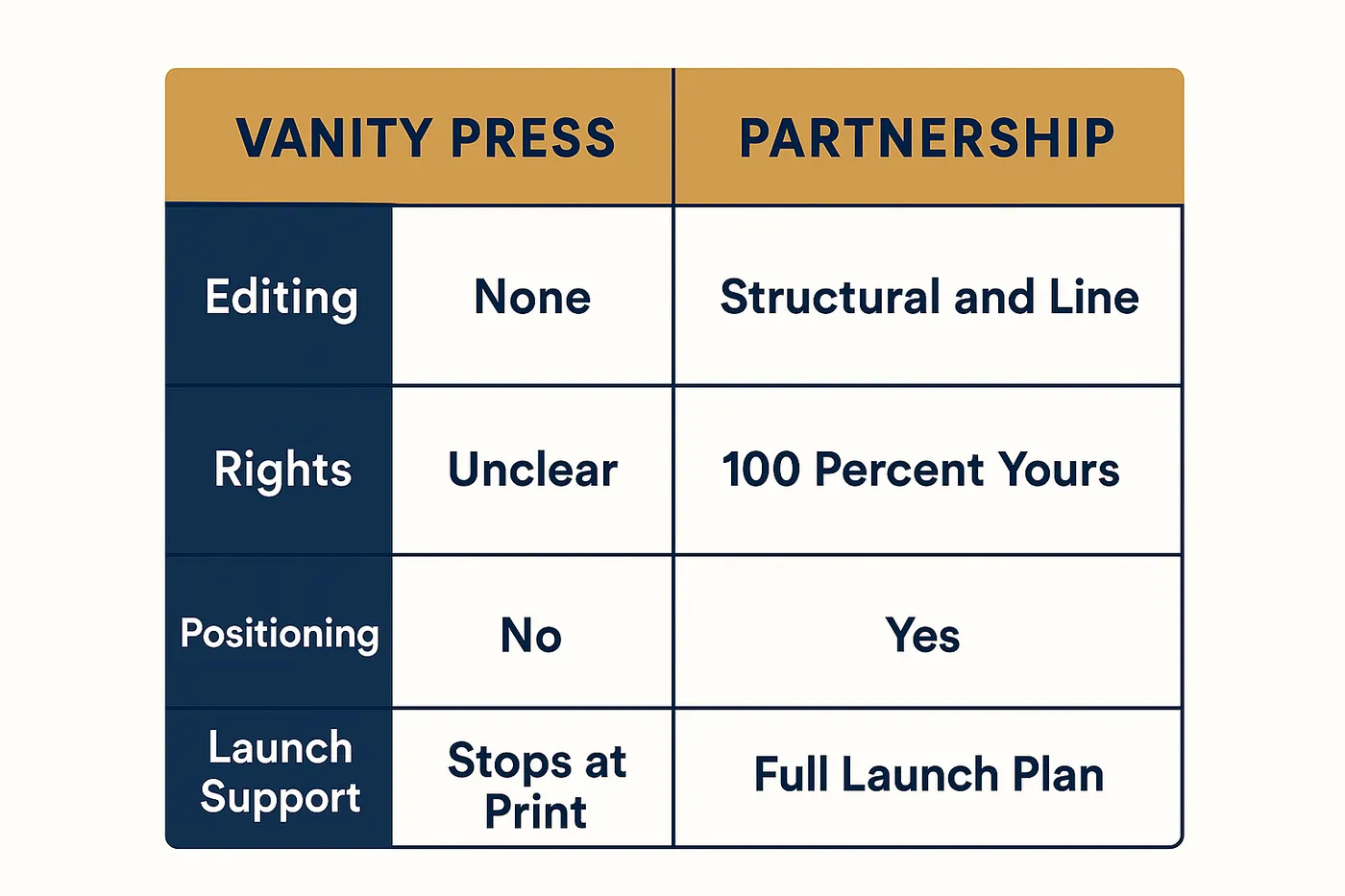
A vanity press typically runs a light proofread, if that, and sends the file to print. That’s a check for typos, not a check for whether the book actually works. A real partnership publisher runs structural and line edits, because a manuscript that hasn’t been shaped by someone other than its author rarely reads the way its author thinks it does. You’re too close to your own material to see where a chapter drags, where an argument skips a step the reader needed, or where the opening three pages fail to earn a fourth.
Ask to see a sample edit before you commit. A real editor will mark up a page of your own writing and show you exactly what they’d change and why. If the answer is vague, or the company can’t produce a sample edit at all, that’s the answer. Structural editing (does the book’s argument or story hold together), line editing (does each sentence do its job), and copy editing (grammar, consistency, typos) are three different skills done by three different passes. A vanity press collapses all three into “we’ll fix any typos we notice.” A partnership publisher treats each pass as its own deliverable, because skipping any one of them shows up in reviews later, not before you’ve already paid.
Do you keep your rights and royalties?
This is non-negotiable on our side, and it should be non-negotiable on yours. You should keep 100% of your rights and royalties in a partnership model: the rights to your own words, in every format, in every territory, for as long as you own them. Some vanity presses bury rights language in a contract you’re expected not to read closely, or grant themselves an exclusive license buried three pages into boilerplate you skim past to get to the part about pricing. Read it closely anyway, and if a clause is unclear, ask the company to rewrite it in plain English before you sign, not after.
Royalties work the same way. A real partnership publisher tells you upfront what percentage of each sale is yours and how often you’re paid. A vague answer here, or a royalty structure that’s “explained on a call” instead of written into the contract, is worth treating as a warning sign rather than an oversight. Get it in writing before a dollar changes hands.
Is there a real positioning stage before writing starts?
Positioning means deciding the one reader, the one promise, and the one shelf your book competes on, before a single chapter gets drafted. A vanity press skips this, because it doesn’t affect their fee either way: they get paid the same whether the book finds its reader or not. A partnership publisher treats positioning as the most important stage in the whole process, because an unpositioned book is the single biggest reason books sell fewer than 100 copies. A book written for “everyone” tends to reach no one, and that failure traces back to a decision (or a missing decision) made before the first draft, not to weak writing.
You can test for this on the very first call. Ask what they’d need to know about your book’s specific reader before they’d start writing or editing. A real answer sounds like a set of pointed questions about your audience, your competition on the shelf, and the one transformation your book promises. A vanity press either skips the question entirely or gives you a generic answer that would apply to any book from any author.
Do they help you launch, or do they stop at “in print”?
Printing a book and launching a book are two different jobs, and conflating them is one of the most common ways authors get surprised after they’ve already paid. A vanity press’s job usually ends the day the file goes live on a retailer; what happens after that is your problem, and most vanity press contracts never say so directly. A partnership publisher builds a launch plan: advance reader copies, a release sequence, and a plan for the weeks after the book goes live, because a book isn’t an event. It’s an asset that needs a push, and then another push after that.
Ask specifically what happens on launch day and what happens the week after. If the answer stops at “we’ll make sure it’s listed correctly,” that’s a printing service wearing a publisher’s name, not a publisher.
Are the founders verifiable?
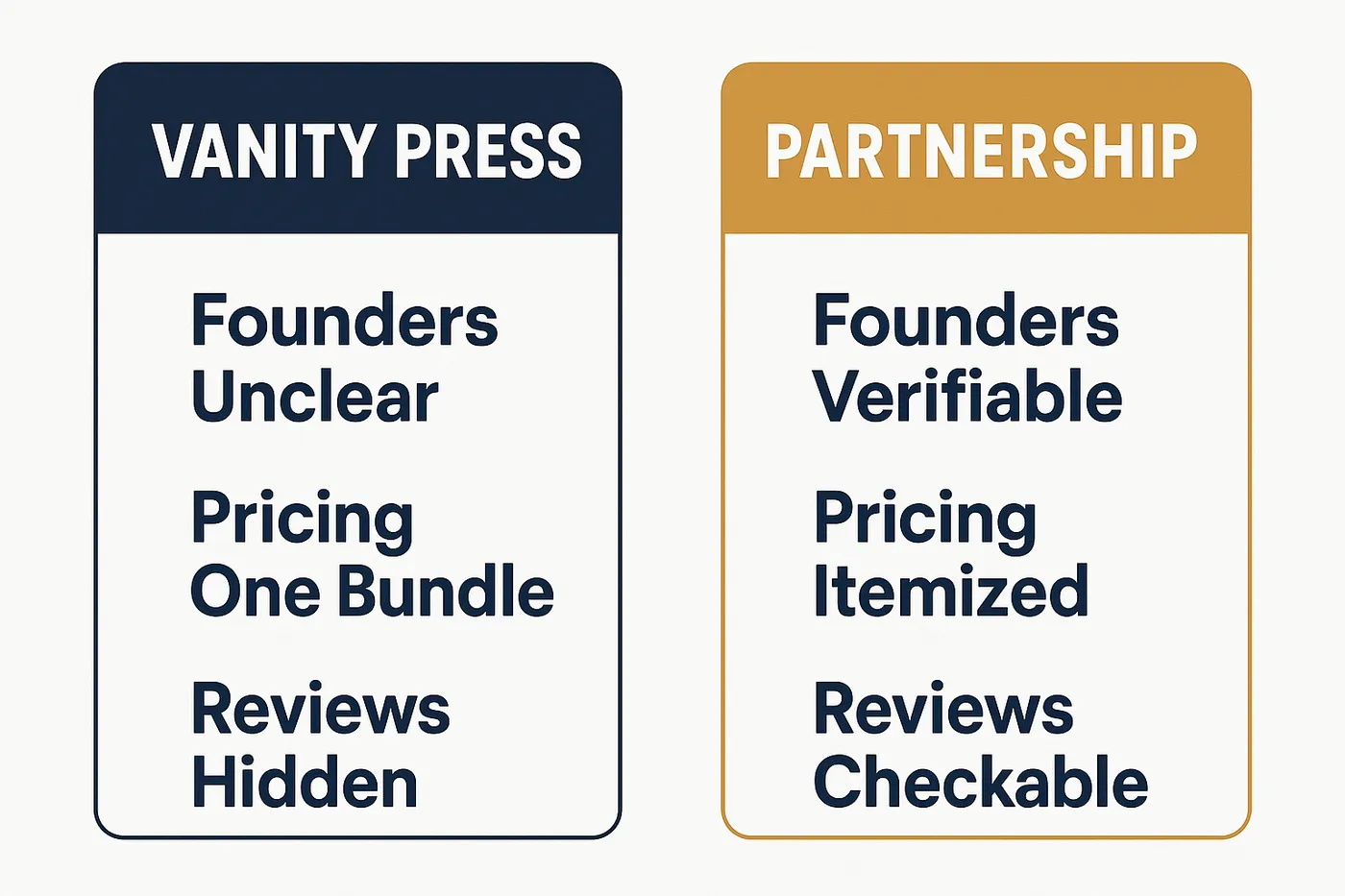
Look up who’s actually running the company. Can you find them, their credentials, and their own track record, independent of their own website? Our founders, Susmita Dutta and Ash Goel, are USA Today and Wall Street Journal bestselling authors and TEDx speakers; that’s checkable on public bestseller lists and TEDx’s own archive, not a claim you have to take on faith from a bio page they wrote themselves. A publisher that can’t be found, or whose “About” page lists no names at all, is a publisher you can’t verify, and a publisher you can’t verify is one you can’t hold accountable if the work falls short.
This matters more in publishing than in most industries, because the product is your name on a cover for the rest of your career. A dry cleaner who does a bad job costs you a shirt. A publisher who does a bad job costs you the credential you were trying to build in the first place, and you often don’t find out until the book is already printed.
Is the price itemized, or one vague bundle?
A partnership publisher should be able to tell you exactly what you’re paying for: writing support, editing passes, design, distribution, and launch, each priced on its own, the same way a contractor itemizes a renovation instead of quoting “the whole house, one number.” A vanity press often quotes one bundled number designed to be hard to compare against anything else, or against what you’d pay piecing the same services together yourself. Vagueness is the tell, not the price itself. A high price with a clear itemized breakdown is a legitimate business decision you can evaluate. A vague price, high or low, is a decision you’re being asked to make blind.
Can you check them on BBB and Trustpilot?
This audience checks before it trusts, and that’s exactly right. A legitimate publisher has a public, checkable reputation on third-party review sites, not just glowing quotes on its own homepage that anyone could write themselves. [NEEDS CONFIRMATION: BBB profile URL] and [NEEDS CONFIRMATION: Trustpilot profile URL] will be linked from our reviews page once confirmed. Ask any publisher you’re considering for the same links, and actually click them, read the negative reviews too, and see how (or whether) the company responded.
In roughly 1,400 prospect conversations we’ve reviewed, about 1 in 6 buyers told us, in their own words, that some part of this decision felt like it might be a scam before they signed. They bought anyway, because the differences above held up when they checked. That’s the bar we hold ourselves to in public, on our trust page, not just in this article.
Two hypothetical authors, two different offers
These aren’t real clients. They’re illustrations of how the same seven differences actually show up on two different calls, since the pattern is easier to spot side by side than one difference at a time.
Author A gets a call back within a day of filling out a form. The rep quotes one bundled number on the spot, mentions “publishing packages” without naming what’s in them, and says a positioning conversation “isn’t really necessary, most authors just want to get their book out.” When Author A asks for a sample edit, the rep says editing is included but doesn’t offer to show one. The company’s name doesn’t turn up on Trustpilot, and the “About” page names no individual founders, just a logo.
Author B books a strategy call for the following week. On that call, someone asks pointed questions about who the book is for and what shelf it competes against, before pricing ever comes up. When Author B asks what’s included, the answer breaks into stages: positioning, manuscript development, three editing passes, design, distribution, and launch, each with its own line item. A sample edit shows up in an email the same day. The founders’ names, credentials, and a public review profile are all one search away.
Same industry, same claimed category (“we help you publish your book”), completely different experience. The seven differences above are exactly what separates them, and they’re checkable in the first conversation, before any money moves.
Five warning signs you can catch in one phone call
You don’t need weeks of research to protect yourself here. Most of what matters shows up in the first conversation, if you know what to listen for.
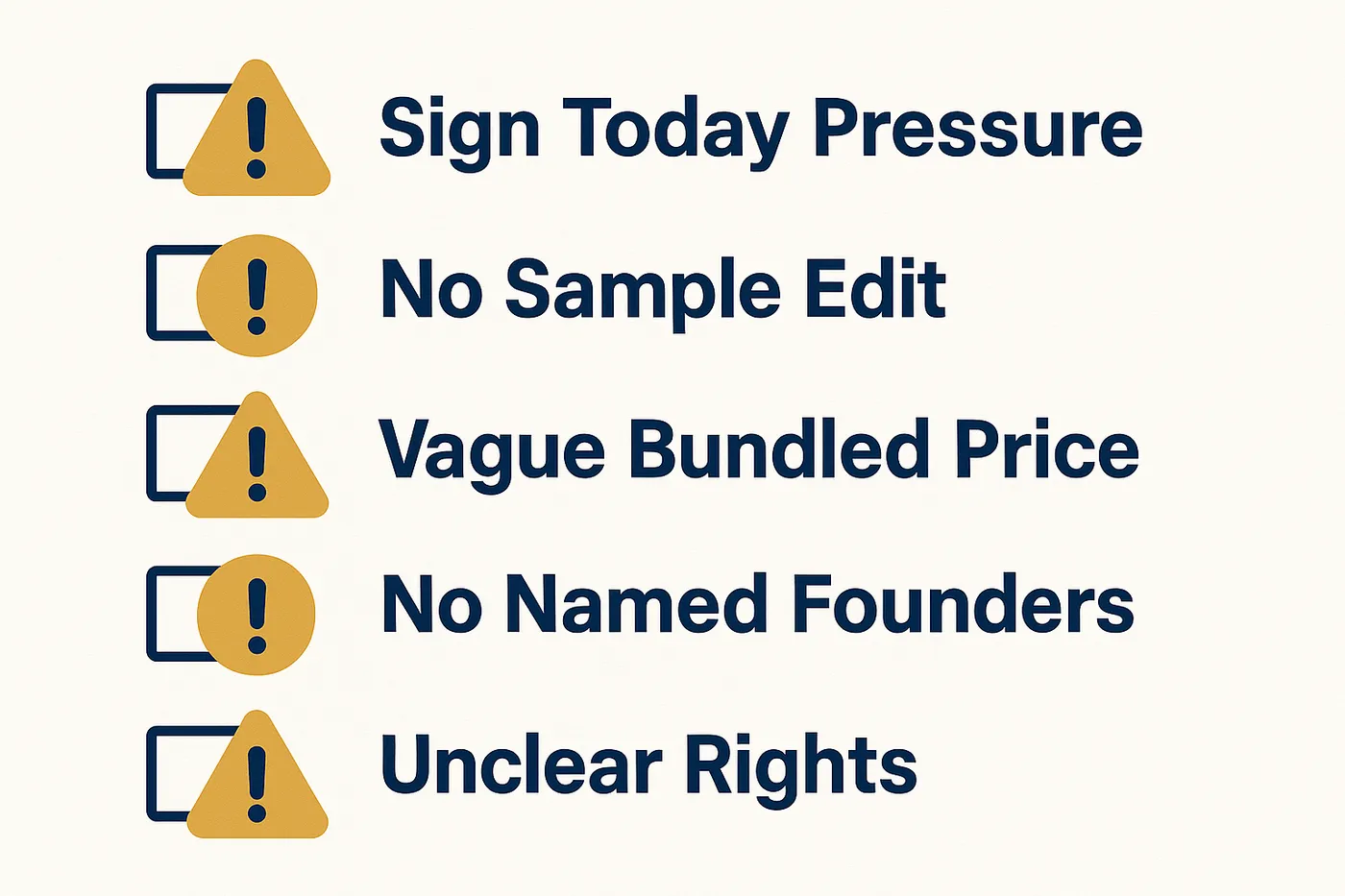
Pressure to sign today, often paired with a “discount” that expires at the end of the call. A real publisher is confident enough in the work to let you take a contract home and read it. No sample edit offered, even after you ask twice. A vague, bundled price with no itemized breakdown available in writing. No named founders you can look up independently of the company’s own marketing. Rights language that’s unclear or gets waved away with “don’t worry about that part, it’s standard.” None of these alone is automatically disqualifying, and a legitimate company might have one awkward answer on an off day. But two or more together, on a single call, is worth walking away from.
What actually happens after you sign
The differences above don’t stop mattering once you’ve paid. They shape the entire experience of the next several months, which is exactly when a bad choice becomes expensive to reverse.
With a vanity press, signing usually means your manuscript goes into a production queue. Your next real contact is often a proof for approval, sometimes weeks or months later, with little or no substantive conversation in between. If you want changes beyond fixing an obvious error, that’s frequently billed as a new service, because the original fee only covered turning a file into a printed book.
With a real partnership publisher, signing is the start of an ongoing working relationship: scheduled editorial calls, drafts you see and respond to at each stage, and a say in cover concepts, launch timing, and how the book is positioned, because you’re the one whose name is on it. The price reflects that ongoing collaboration, not a single file conversion. If a company can’t describe what your calendar looks like for the next few months after signing, ask them to, before you commit.
How to read the contract yourself in ten minutes
You don’t need a lawyer to catch most of what matters, though a lawyer reviewing a five-figure contract before you sign is never a bad idea. Before you sign anything, find and read five specific clauses:
The rights clause. Look for the words “exclusive,” “in perpetuity,” or “all formats and territories.” A partnership contract should say plainly that you retain your copyright and grant only what’s needed to produce and distribute the book, not a permanent, all-format transfer.
The royalty clause. It should state a specific percentage and a specific payment schedule, not “to be determined” or “industry standard,” which means nothing on its own.
The revision clause. Ask what happens if you want a change after a stage is marked complete. A fair contract says how many rounds of revision are included at each stage and what an additional round costs if you need one. A vague or missing revision clause is how a “included editing” turns into a surprise invoice.
The cancellation clause. What happens to money you’ve already paid if you need to pause or stop the project partway through? A company confident in its own work will spell this out in writing.
The deliverables list. The clearest possible sign of a real contract is a specific, itemized list of what you get at each stage, in the contract itself, not just in a sales conversation. If the contract is vaguer than the pitch you got on the phone, that gap is the tell.
None of this requires special training. It requires reading the document slowly, before you sign it, and asking the company to rewrite in plain English anything you can’t follow. A company that resists that request has told you something important about how it treats the rest of the relationship.
What if you already signed with a vanity press?
If you’re reading this after the fact, you’re not the first author in this position, and it’s a fixable problem, not a permanent one. Depending on what you actually own the rights to and what condition the manuscript and files are in, a relaunch under real positioning, a proper edit, a redesigned cover, and an actual launch plan can turn a book that sold a handful of copies into one that finally reaches its reader. Book Relaunch exists specifically for this situation: books that were printed but never properly launched, or launched with a design and positioning that didn’t earn the reader’s attention.
The first step is figuring out exactly what you own: check your existing contract for the rights clause described above, and see whether the files (manuscript, cover, interior layout) are yours to reuse or locked to the original printer. That answer shapes whether a relaunch starts from your existing manuscript or needs a fuller rebuild. Either way, the sooner you get a second, honest opinion on what happened, the sooner you stop losing time to a launch that already failed once.
Is the term “hybrid” ever used dishonestly?
Yes, and that’s worth saying plainly. “Hybrid publisher” doesn’t have a legally protected definition the way “CPA” or “licensed contractor” does, so any company can put the word on its homepage regardless of what it actually delivers. Some businesses that operate exactly like a vanity press, no editing, no positioning, no launch support, have simply relabeled themselves “hybrid” because the term carries less baggage than it used to.
That’s exactly why this article leads with differences you can check, not a label you have to trust. The name on the door tells you what a company wants to be called. The seven differences above tell you what a company actually does. Run the checklist regardless of which word is on their homepage, because the word alone protects you from nothing.
Myths that make a vanity press feel safer than it is
A few assumptions come up on almost every call we have with an author who’s already had a bad experience elsewhere. None of them hold up once you check the seven differences against them.
“They have a professional-looking website, so the process must be professional too.” Website design has nothing to do with whether a manuscript gets a real edit. A polished homepage is a marketing expense, not a proof of editorial quality, and it’s often cheaper to produce than the editing it’s standing in for.
“They quoted a high price, so it must include real work.” Price and quality aren’t the same axis. A high price with a vague, bundled quote tells you the price is high, not what it buys. Compare the price against the itemized list, not against your assumption of what a big number should include.
“A lot of authors have used them, so it must be legitimate.” Volume tells you a company is good at acquiring customers, not that those customers are satisfied with the result. Check the actual reviews, especially the negative ones and how the company responded, rather than the headcount.
“They gave me a fast turnaround, which means they’re efficient.” A fast turnaround on a manuscript that needed structural editing usually means the editing didn’t happen, not that the company works quickly. Ask what specifically happens during that turnaround window before treating speed as a selling point.
Each of these myths substitutes an easy-to-observe surface signal for the harder question underneath it. The seven differences in this article are designed to answer the harder question directly, which is exactly why they’re worth running down before you sign, regardless of how good the website looks or how fast the quote comes back.
If anyone offers to publish your book without involving you in the decisions, run. That’s the whole test, in one line. For the honest numbers behind these differences, see how much hybrid publishing actually costs. If you’re ready to have someone walk your specific situation through this checklist, book a strategy call and bring your questions.