
Short answer: most professionals move from idea to published nonfiction book in 6 to 12 months: about a month on positioning, 8 to 16 weeks on the manuscript, then 8 to 14 weeks on editing, design, and launch setup. The writing itself rarely takes as long as people fear. What takes time is doing the stages in the right order instead of skipping straight to a blank page.
Key takeaways
- Month one is positioning, not writing, and skipping it is the top cause of a rewritten chapter three.
- The manuscript stage itself runs 8 to 16 weeks with structured extraction, not months of solo drafting.
- Editing, design, and launch setup take another 8 to 14 weeks after the manuscript is done.
- Going faster means cutting wasted motion, not cutting editing or positioning.
- The single biggest timeline variable isn't writing speed. It's how much usable material you're starting with.
What actually happens in month one?
Positioning, not writing. The first stage decides the one reader, the one promise, and the shelf this book competes on. Skipping this feels like progress, because pages get written, but it’s the single biggest reason authors end up rewriting chapter three for months. Get this right first and the rest of the timeline shortens.
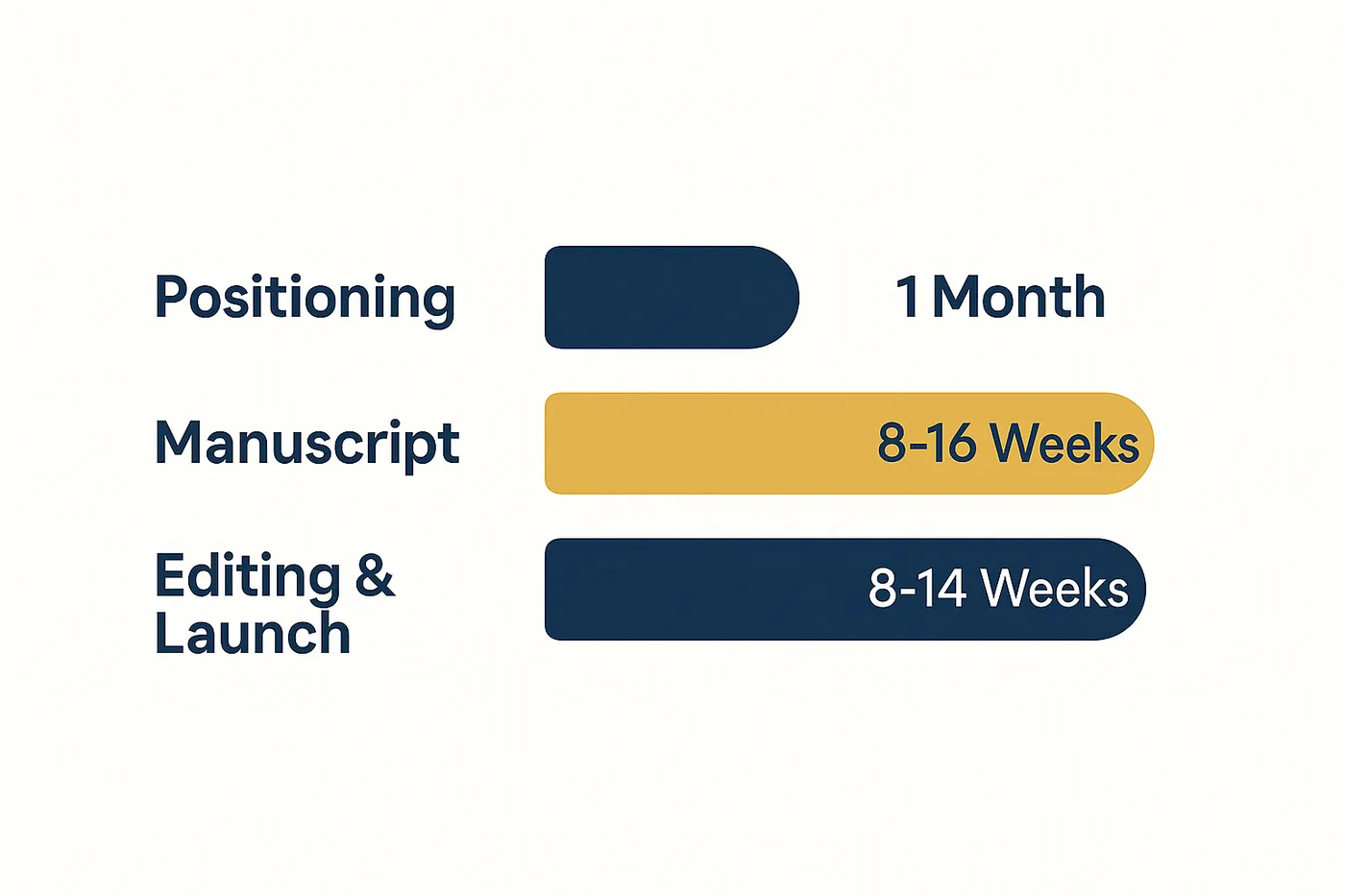
Positioning sounds like a strategy exercise, and it is one, but it’s a fast one when it’s structured. Most authors move through it in a handful of focused sessions over two to four weeks: naming the one reader this book is actually for, the one transformation or promise it delivers, and the two or three competing books on the shelf it needs to stand apart from. That’s a small amount of calendar time that changes the shape of everything written after it.
How long does the actual manuscript take?
For most professionals working with structured extraction, this stage runs 8 to 16 weeks, depending on book length and how much material already exists in talks, notes, or a rough draft. You’re not writing alone at a keyboard for six months straight. You’re talking through what you know in scheduled sessions, and someone else shapes it into a manuscript you then review line by line.
The range is wide on purpose, because two authors with the same book length can land at very different points in it depending entirely on their starting material. An author with years of talks, blog posts, and client case notes to draw from moves through extraction faster, since a lot of the raw thinking already exists in some form. An author starting from a genuinely blank page, with the expertise in their head but nothing yet written down anywhere, needs more sessions to get the same material out, which is normal and not a sign anything is going wrong.
What happens between “manuscript done” and “book published”?
This is where a lot of authors expect the process to be nearly over, and it’s actually where a large share of the real work lives: developmental and line editing, cover and interior design, ISBN and distribution setup, and a launch plan built around a real release date. Budget 8 to 14 weeks here, depending on how many editing passes the book needs.
Each piece of that window runs partly in parallel, not entirely end to end, which is part of why the range compresses or stretches depending on the book. Developmental editing usually starts as soon as full chapters exist, before the very last chapter is even drafted. Cover concepts can start once positioning has settled the genre and shelf, well before editing finishes. Distribution setup, ISBN registration, and metadata work happen in the background while editing continues. Launch planning, advance copies, and outreach usually start 6 to 8 weeks before the release date itself, which means launch prep and the final editing pass often overlap rather than stack one after the other.
What does a realistic month-by-month timeline actually look like?
Stage names are useful for understanding what’s happening, but most authors want to see it laid out on an actual calendar. Here’s roughly how a 9 to 12 month timeline breaks down for a typical professional working with structured extraction and a standard editing schedule, assuming a normal week of availability rather than a compressed sprint.
Weeks 1 to 4 are positioning: naming the reader, the promise, and the competitive shelf. Weeks 5 to 16 are manuscript development, structured extraction sessions with review and revision built in as chapters come back. Weeks 17 to 24 are developmental and line editing, running partly alongside the tail end of manuscript work if extraction finished a little early. Weeks 20 to 28 are design, cover concepts and interior formatting, overlapping editing rather than waiting for it to fully finish. Weeks 26 to 34 are distribution setup and final proofing, and weeks 30 to 40 are launch preparation and the release window itself. Lay all of that on a calendar and it lands most professionals somewhere between month 8 and month 10 for a genuinely typical project, with room on either side depending on book length and how many editing passes a specific manuscript needs.
What’s the difference between a fast, typical, and extended timeline?
“How long does this take” usually has three honest answers depending on the author’s starting material and schedule, not one single number that applies to everyone.
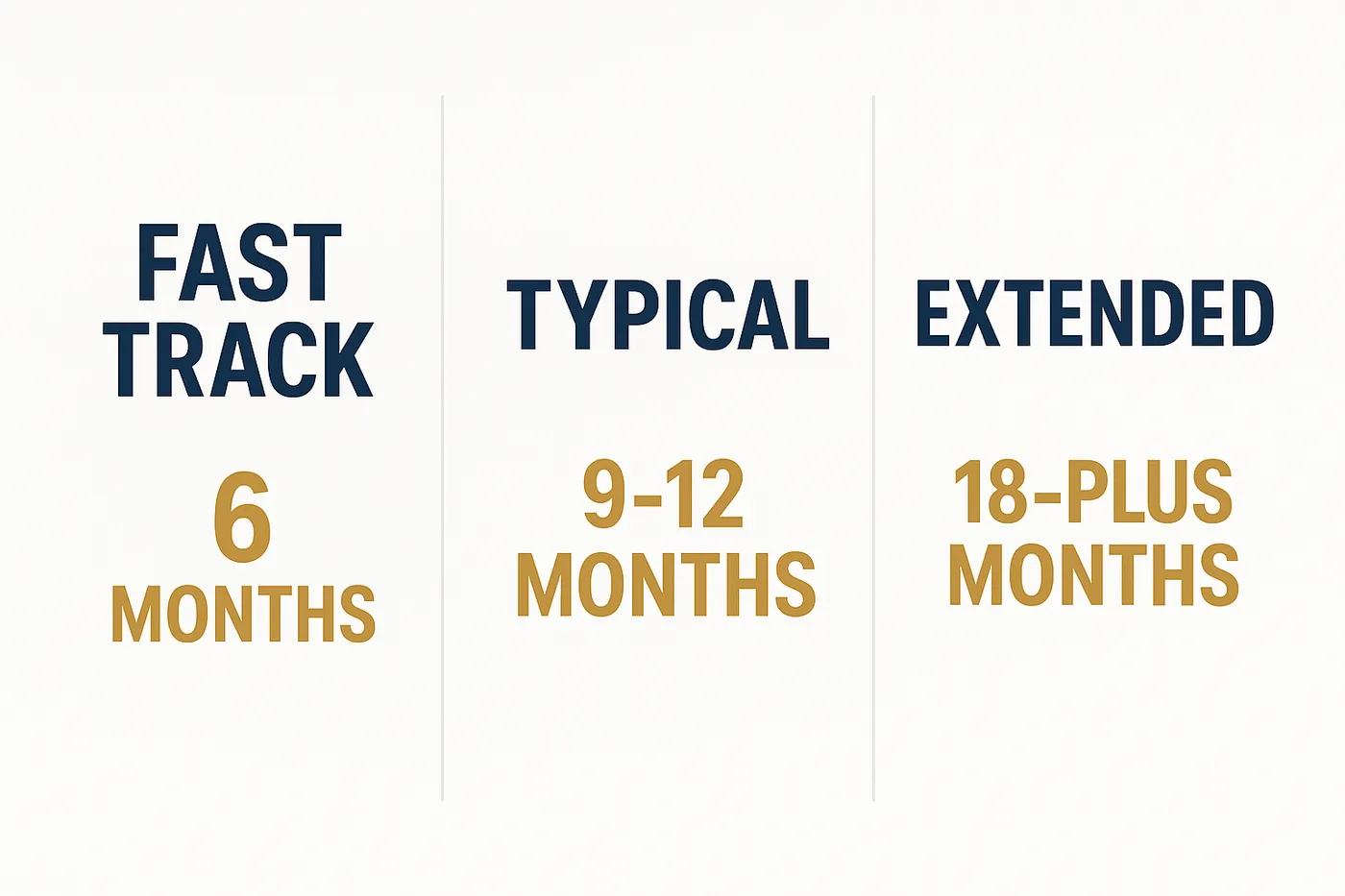
A fast track, around 6 months, is realistic for an author who already has a clear outline, years of usable material like talks or blog posts, and a schedule that allows more frequent extraction sessions than the standard cadence. A typical timeline, 9 to 12 months, fits most working professionals: a full-time job or practice, a normal cadence of sessions, and a standard editing and design schedule. An extended timeline, 18 months or more, usually isn’t a sign anything went wrong; it’s what happens when an author’s schedule genuinely only allows sessions once or twice a month, when a book needs an added technical or compliance review, or when the author deliberately chooses to slow down around a busy season in their own work. All three are legitimate outcomes of the same process. The variable is the author’s starting point and calendar, not the quality of the work, and none of the three ranges skips a stage to get there; they simply move through the same stages at a different pace.
Two hypothetical authors, two different timelines
These aren’t real clients. They’re illustrations of how the same process produces genuinely different timelines depending on where an author starts, since that’s usually what actually drives the number, not how fast someone writes.
Author A has given the same keynote for four years, has a stack of blog posts on the topic, and already has a rough chapter outline sketched out. Her positioning stage moves quickly because she already knows her reader from years of speaking to them directly. Her manuscript stage lands near the shorter end of the range, since a meaningful share of the raw material already exists and mostly needs shaping, not creating from scratch. She’s realistically looking at something close to the fast-track end of the range.
Author B has deep expertise built over a twenty-year career but has never turned any of it into a talk, a blog post, or even organized notes. His positioning stage takes a little longer, since the one-reader, one-promise decision has to be worked out from scratch rather than pulled from years of already-tested material. His manuscript stage lands near the longer end of the range, since every chapter starts from a genuinely blank page in extraction sessions rather than from existing material being reshaped. He’s realistically looking at the typical-to-extended end of the range, and that’s not a problem to solve. It’s just what an honest timeline looks like for his specific starting point.
Same process, same stages, different calendar, entirely because of what each author walked in with, not because one of them is a stronger writer or a harder worker than the other.
Does the type of book change the timeline?
Somewhat, and it’s worth naming which part of the process actually shifts, since it’s rarely the whole timeline that moves.
- Business and leadership books usually move at the standard pace described above, since the framework-building happens inside the normal positioning and manuscript stages rather than adding a separate step.
- Memoirs often add time to the manuscript stage specifically, not the whole project, since narrative pacing and scene-setting take more editing passes than a straightforward how-to structure.
- Self-help and how-to books can move slightly faster through manuscript development, since the structure (clear steps, exercises) gives extraction sessions a built-in shape to follow, but sometimes need an added design pass for worksheets or exercise formatting.
- Health, medical, and other regulated-expertise books sometimes add a review step for claims and accuracy that runs alongside editing, which can add a few weeks depending on how much the content needs checking against current guidance.
None of these differences are large enough to change which range you’re in (fast, typical, or extended). They shift which specific stage carries the extra time, which is useful to know going in rather than discovering it mid-project.
What if the launch needs to line up with something else?
A lot of professional authors aren’t just publishing a book. They’re timing it to a conference keynote, a program launch, a firm anniversary, or another business milestone that already has its own date attached. That changes the planning question from “how long will this take” to “what does the calendar need to look like working backward from a date that isn’t moving.”
Working backward is usually the more reliable way to plan when there’s a fixed external date. Start from the launch date, subtract the 8 to 14 week editing-and-launch-setup window, subtract the 8 to 16 week manuscript window before that, subtract the roughly one-month positioning stage before that, and see what start date falls out the other end. If that start date is already in the past, the honest options are compressing the schedule (more frequent sessions, not fewer editing passes), moving the target date, or accepting that this particular milestone won’t be the launch date and planning the book on its own timeline instead. All three are legitimate choices. The mistake is discovering the conflict two months before the conference instead of on day one.
How does a demanding day job actually change the number?
Every timeline in this article assumes a working professional’s normal schedule, not a sabbatical, which is exactly the population most of our authors come from: physicians, attorneys, founders, consultants, and other people whose calendars are already full. The honest answer to “but I have zero free time” isn’t a different, faster process. It’s that structured extraction is built around short, scheduled sessions rather than long open-ended writing blocks, precisely because long open-ended blocks are the thing a full career rarely has to spare.
What actually changes the timeline for a busy schedule isn’t the total hours required, which stays fairly stable across authors, but the frequency of sessions. An author who can commit to a session every week moves through the manuscript stage near the shorter end of its range. An author who can only manage a session every three or four weeks, because of an unusually demanding season at work, moves through the same stage more slowly, not because the work is harder, but because the calendar between sessions stretches out. That’s a scheduling reality worth planning around honestly rather than a reason to assume the process won’t fit a full career. Most of the professionals we work with have exactly this kind of calendar, which is the whole reason the process is built around short sessions in the first place.
What slows a timeline down after positioning is already done?
Skipping positioning is the single biggest cause of a stalled timeline, but it’s not the only one. A handful of smaller friction points show up often enough to name specifically, since each one is avoidable once you know to watch for it.
Slow turnaround on manuscript reviews is the most common one. Structured extraction moves fast on the front end, but if draft chapters sit in an author’s inbox for three weeks before they’re reviewed and sent back, that delay stacks up across a dozen chapters into real months, even though the actual reading and commenting takes an hour. Treating chapter review like any other calendar commitment, not an optional task for a slow week, is what keeps this stage on schedule.
Decision fatigue on design is the second. A cover concept round can turn into six rounds if an author can’t settle on a direction, usually because the earlier positioning work didn’t fully answer what shelf the book needs to compete on. This is one more reason a tight positioning stage pays off later: it gives the design stage a clear target instead of an open-ended “I’ll know it when I see it” search.
Unclear approval chains are the third, especially for authors publishing under a company, practice, or co-author relationship. If a manuscript needs sign-off from a business partner, a marketing team, or a compliance reviewer, and nobody has agreed in advance how fast that sign-off happens, it can add unplanned weeks at exactly the stage where the book feels almost done. Naming who needs to approve what, and by when, before the manuscript reaches them, is a small planning step that prevents a real bottleneck later.
None of these three are reasons to expect a longer timeline by default. They’re the specific, nameable things that turn a normal 9 to 12 month project into an 18-month one, and each is fixable with a small amount of upfront planning rather than a fundamentally different process.
Why do some authors take years instead of months?
Almost always because they tried to do it alone, without a structure, squeezed between a demanding career and a blank page at night. One of our authors first thought about her book in high school and didn’t start it for 51 years. She’s not unusual. In our intake data, nearly half of the authors who eventually came to us had waited years, sometimes decades, before starting, not because the book wasn’t ready, but because the path wasn’t clear.
That gap usually isn’t a motivation problem. It’s a sequencing problem. Writing without positioning first means starting over more than once. Editing without a real schedule means a manuscript that sits half-finished for months at a time. A launch with no plan means a finished book that never actually gets a real release, which quietly turns “published” into “uploaded and forgotten.” Each of those gaps adds months or years on its own, and they tend to compound rather than stay separate problems.
Does going faster mean a worse book?
Not if the sequence stays intact. Speed comes from skipping wasted motion, like six months of directionless drafting, not from skipping stages like editing or positioning. A book rushed past those stages usually shows it, and it’s the kind of book that ends up needing a relaunch later.
The honest way to think about compressing a timeline is to ask what’s actually being cut. Cutting the gap between sessions, tightening the calendar so extraction happens weekly instead of monthly, is a real, safe way to move faster. Cutting an editing pass, or skipping the positioning stage to get to a draft sooner, isn’t compression. It’s deferral, and the time it saves now usually gets paid back later with interest, in the form of a rewrite, a relaunch, or a book that undersells because it never had a clear reader in the first place.
What can you actually do this month to start the clock?
If the timeline above feels abstract, here’s what starting actually looks like in practice, broken into the handful of decisions that move a project from “someday” to a real calendar with a real launch date on it.
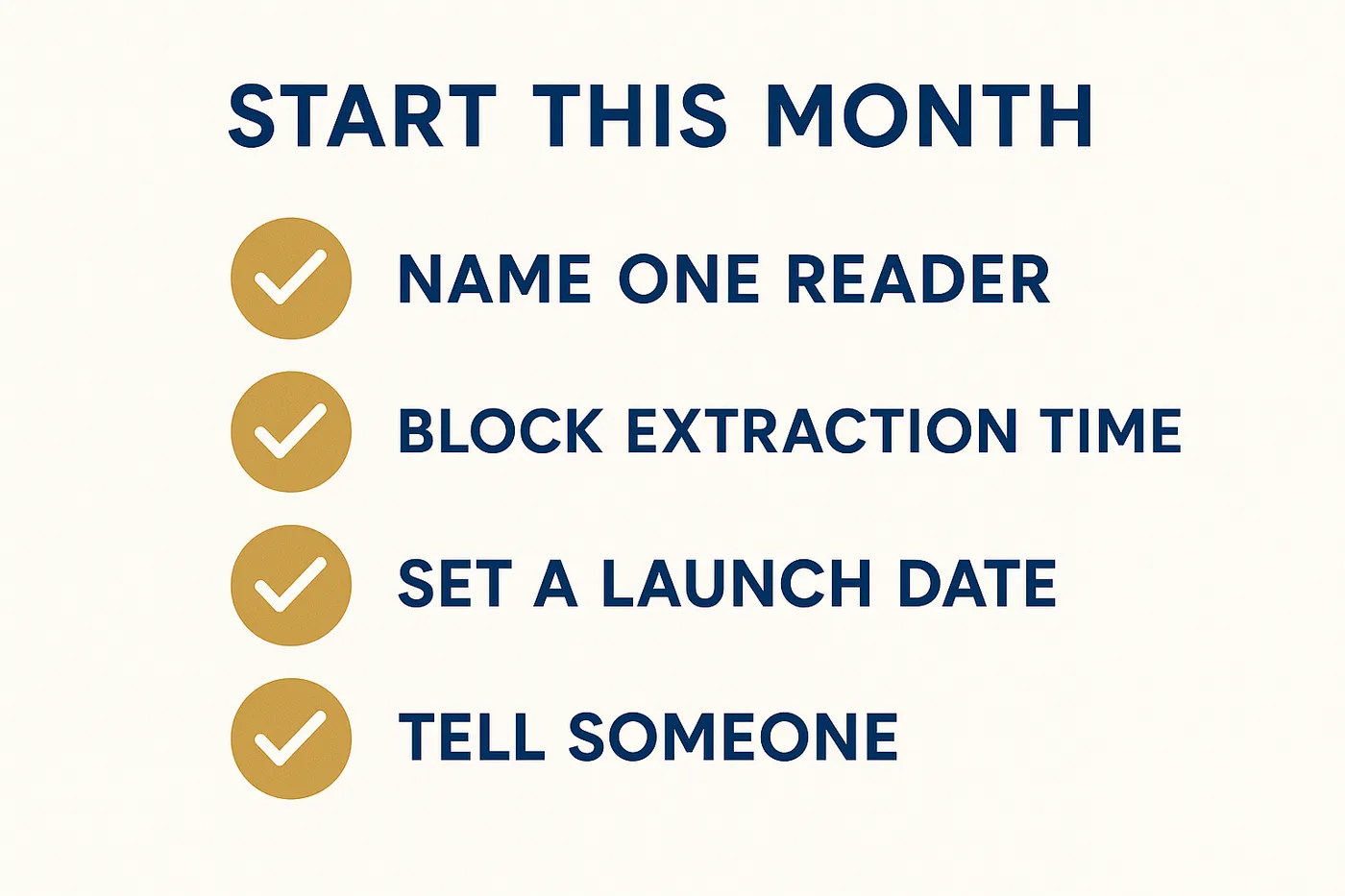
Name one reader, even roughly, before anything else; you can sharpen it later, but a fuzzy first answer beats no answer. Block real time on your actual calendar for extraction sessions, the same way you’d block time for anything else that matters, since “whenever I find time” is how a book quietly becomes a decade-long someday. Set a rough launch date, even a season rather than an exact day, because a target date is what turns the stages above into a real schedule instead of an open-ended project. Tell someone, a colleague, a coach, a strategy call, since a book that only exists in your own head is the easiest kind of project to quietly let slide, and the easiest kind to actually finish once someone else is expecting to hear how it’s going.
None of these four things require the book to be positioned, drafted, or even fully thought through yet. They just require a decision to start the clock, which is usually the actual hardest part, more than any single stage that comes after it.
Whatever range you land in, fast, typical, or extended, the number that actually matters isn’t how it compares to someone else’s timeline. It’s whether the sequence stayed intact: positioning before writing, structured sessions instead of solo drafting, editing that gets its full passes, and a launch that was actually planned instead of assumed. A book built in that order and finished in 14 months will outperform a book that skipped positioning and got rushed out in 5, almost every time.
If you want to see exactly what each stage includes, Book Writing and Book Publishing break the deliverables down by stage and timeline. For the honest cost that goes with this timeline, read how much hybrid publishing costs. And if your book is already written and you’re wondering what comes next, see I finished my manuscript. Now what?