
Short answer: a finished manuscript is closer to the halfway point than the finish line, and that’s good news, not bad news: the hardest, most uncertain stage is behind you. What’s left is a known sequence of 9 steps, not a mystery, and most authors move from finished manuscript to published, promoted book in 3 to 5 months.
Most first-time authors underestimate this part, not because they’re careless, but because the manuscript is the part of the process they can picture. Writing has a clear finish line: the last page. Everything after that (editing, design, distribution, launch) is less visible from the outside, which is exactly why it gets skipped, rushed, or handed to whoever’s cheapest instead of whoever’s good at it. This guide breaks the remaining distance into nine concrete steps, in order, so “now what” has an actual answer instead of a guess.
Key takeaways
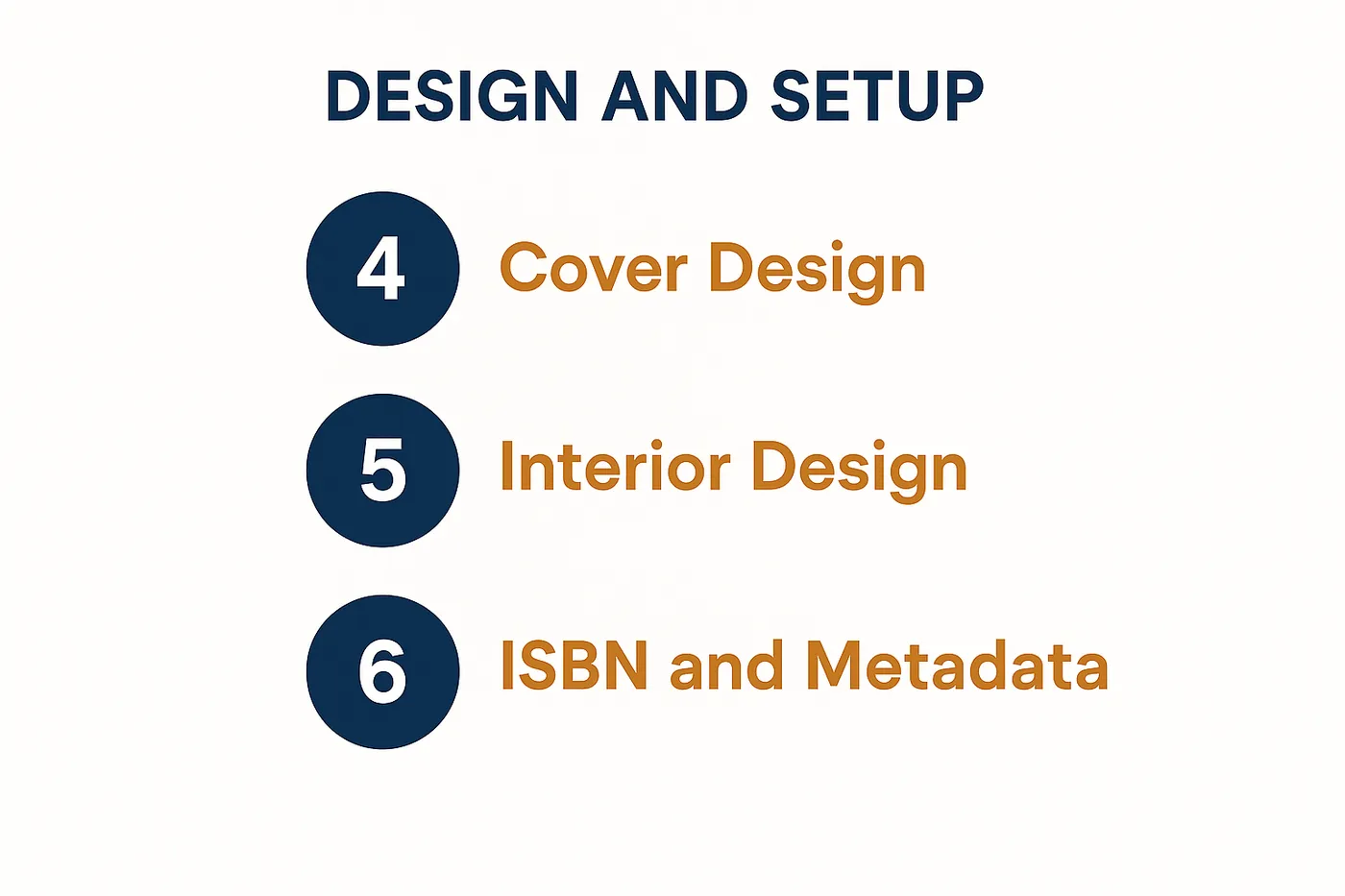
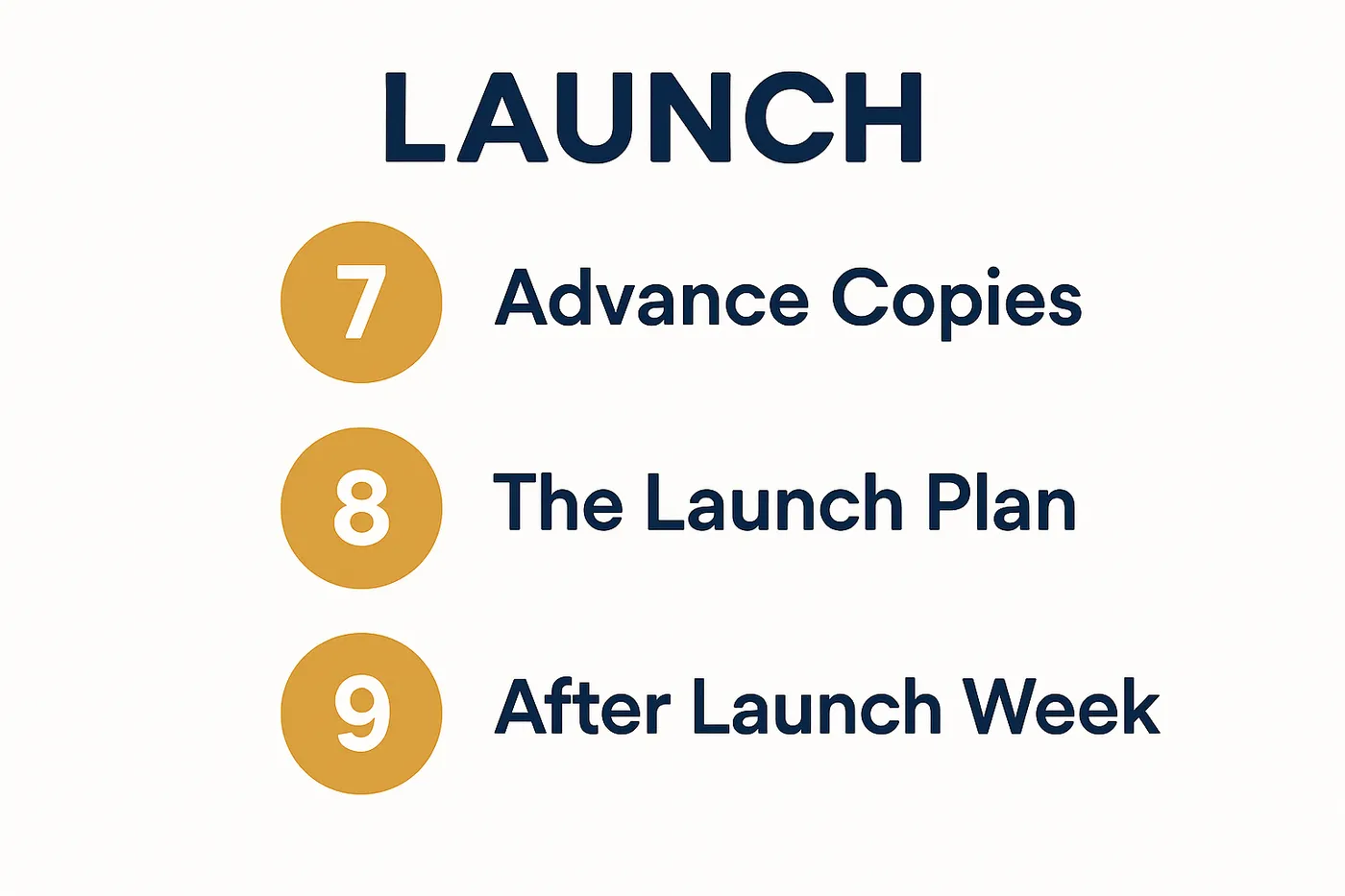
- The 9 steps split into three phases: editing (steps 1-3), design and setup (steps 4-6), and launch (steps 7-9).
- Most authors move from finished manuscript to launched book in 3 to 5 months.
- Steps 8 and 9, the launch plan and what happens after, are the most commonly skipped, and the most common reason a well-written book still undersells.
- Editing, cover design, and metadata are worth hiring out even if you handle your own launch-week promotion.
Step 1: Developmental editing
Before anything else, a developmental editor reads for structure: does the argument hold together, does the story arc land, is anything missing that the reader needs. This is the step most first-time authors underestimate, because the manuscript already feels finished to the person who wrote it. You’ve read your own chapters a dozen times. You know what you meant. A developmental editor doesn’t have that context, which is exactly why they can see the gap between what you meant and what’s actually on the page.
A real developmental edit comes back as a letter or annotated outline, not just margin comments: which chapters carry their weight, where the argument or story loses momentum, what a reader would need earlier than you gave it to them. If the “developmental edit” you’re offered is really just a light copyedit with a different name, that’s worth catching before you pay for the next stage on top of an unaddressed structural problem.
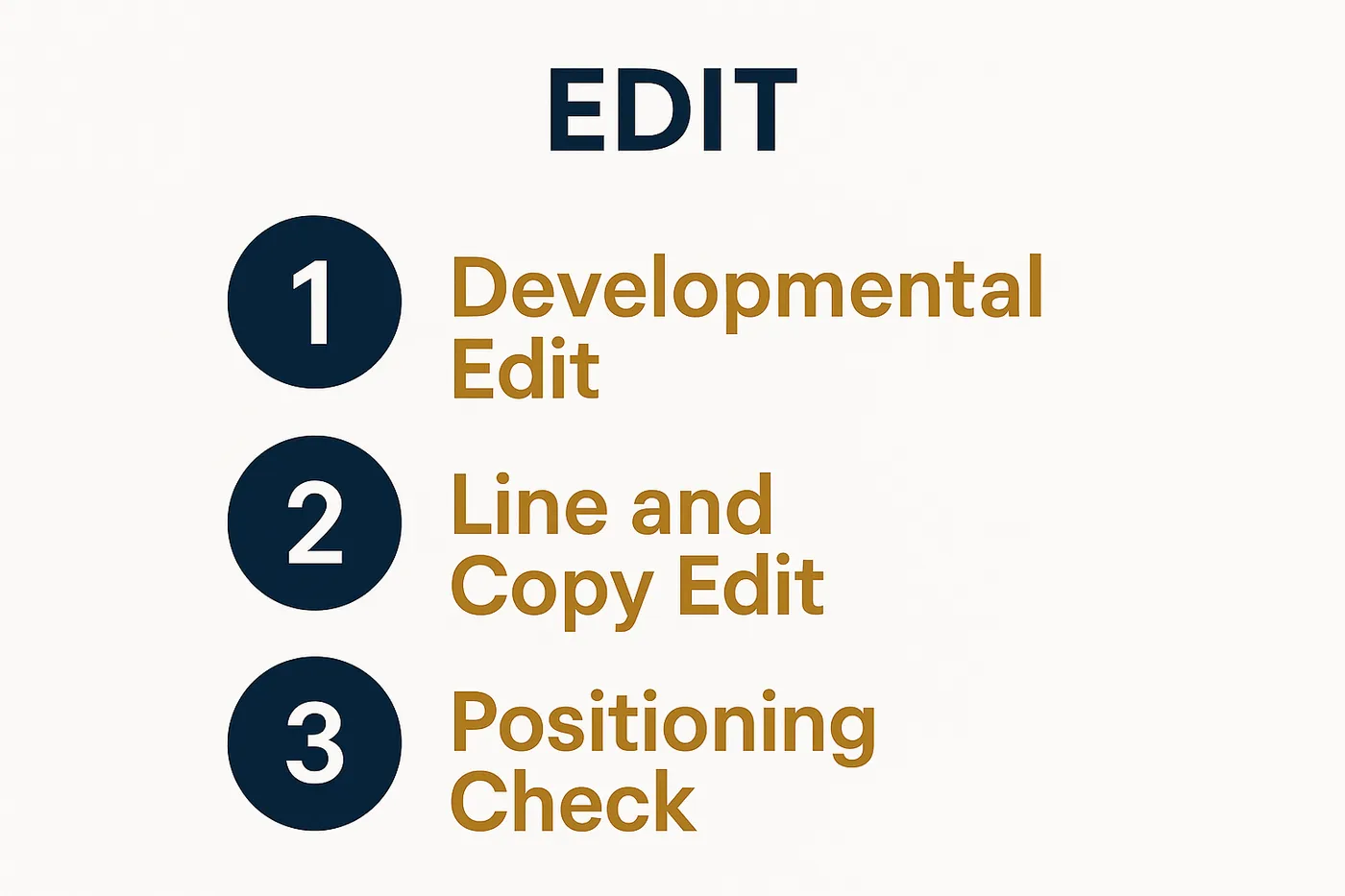
Step 2: Line and copy editing
Sentence-level work: clarity, rhythm, grammar, and making sure your voice survives the process instead of getting flattened into something generic. Line editing and copy editing are two different jobs done in sequence. Line editing shapes how sentences and paragraphs actually read, cutting clutter and sharpening the parts that drag. Copy editing catches grammar, punctuation, and consistency (does a name get spelled the same way on page 12 and page 200) after the line-level shape is settled.
Ask to see a sample edit before you commit to an editor for this stage. If it sounds like someone else wrote it, that’s the wrong editor; a good line edit tightens your sentences without replacing your voice with a generic “professional” one. This is also the stage where inconsistencies hide: a character’s age that shifts, a statistic quoted two different ways, a term you define once and then use loosely afterward. Catching these here is far cheaper than catching them after the book is printed.
Step 3: Positioning check
Even if positioning happened before writing started, it gets revisited here. Does the finished manuscript still match the one reader and one promise it was built around? Small drifts happen during drafting: a business book that started as a leadership framework sometimes wanders into memoir territory by chapter 8, or a self-help book’s promised takeaways get diluted by tangents that felt important while writing but don’t serve the reader the book was built for.
This is the last checkpoint to catch that drift before design locks the book in place, because a cover, title, and back-cover copy all get built around whatever the manuscript actually promises at this point. Skipping this check doesn’t just risk a slightly-off book. It risks a cover and marketing message built around a promise the interior doesn’t fully deliver, which is a more expensive problem to fix after the design stage than before it.
Step 4: Cover design
A cover has one job: to make the right reader stop scrolling. This isn’t decoration. It’s the single highest-leverage design decision in the entire process, tested against the genre shelf the book actually competes on, not judged in isolation on your own screen. A cover that “looks nice” to the author but doesn’t read as a business book, memoir, or self-help title at a glance will lose readers before they ever open the page, because most buying decisions on a retail page happen in a couple of seconds.
A real cover process includes concepts tested against comparable titles already selling in your category, not just one designer’s personal taste. Ask to see comparable covers in your genre before the first concept round starts, so the design has a real target instead of a guess.
Step 5: Interior design and formatting
Typesetting, chapter breaks, front and back matter, and formatting for both print and digital editions. Small details here, like a cramped page or an inconsistent header, are the fastest way to make a professionally written book look amateur. Print and ebook formatting are two separate jobs: a layout that looks clean on a 6-by-9-inch printed page doesn’t automatically translate to an e-reader, where font size and line breaks are set by the reader’s device, not the designer.
Front matter (title page, copyright page, dedication, table of contents) and back matter (acknowledgments, about-the-author page, a call to action pointing readers to your next step) both matter more than most authors expect. The about-the-author page and back-matter call to action are often the only place in the entire book where a reader is invited to take a next step with you, and a book that ends abruptly on the last chapter wastes that opportunity.
Step 6: ISBN, metadata, and distribution setup
Getting the book listed correctly everywhere books are sold: the right categories, the right keywords, the right metadata so the book is findable by the reader it was written for, not buried under a thousand similar titles. An ISBN identifies an edition of your book (print, ebook, and audiobook each need their own), and getting categories right on retail platforms is the difference between showing up on the first page of a relevant search and disappearing into a category with ten thousand other titles.
This step is easy to underestimate because it looks like paperwork, not craft. It isn’t. A book with the wrong category or thin, generic keywords can be well written, well edited, and beautifully designed, and still be effectively invisible to the reader searching for exactly what it offers.
Step 7: Advance copies and early reviews
Real reviews take time to accumulate, and a launch without any is a launch without social proof. Advance reader copies (ARCs) go out before the public launch date specifically to build that early base, so the book has genuine reviews visible on day one instead of launching into an empty review section that makes even a great book look untested.
Building an ARC list takes real lead time, usually four to eight weeks before launch, since reviewers need time to actually read the book before posting anything. Authors who skip this step, or start it too late, are the ones who launch to a review section with zero or one review, which quietly signals “untested” to every reader who lands on the page in the first critical weeks.
Step 8: The launch plan
A specific date, a sequence of announcements, and a plan for the first two weeks, not just the first day. This is the step most likely to be skipped by authors who publish alone, and it’s the reason so many well-written books quietly sell under 100 copies. A launch plan usually includes a countdown sequence in the weeks before the date, a coordinated push across email, social, and any speaking or media opportunities on launch day itself, and a specific plan for the two weeks after, when most of the actual buying decisions happen as word spreads past the first wave of buyers.
Without a plan, launch day becomes a single social post and then silence. With one, launch day is the visible peak of a sequence that started weeks earlier and continues for weeks after, which is a structurally different outcome even for the exact same book.
Step 9: What happens after launch week
A book isn’t an event. It’s an asset that needs quarterly pushes: speaking opportunities, media, courses, and continued promotion months after the launch date has passed. Authors who stop at step 8 are the ones who come back later asking why the book isn’t selling, and the honest answer is usually that nothing has actively promoted it since week one.
Quarterly pushes don’t need to be elaborate. A speaking engagement that mentions the book, a podcast appearance, a seasonal promotion tied to a relevant date, or a fresh round of outreach to a new audience segment all keep the book moving instead of letting it go quiet the moment the initial launch energy fades. In our intake data, the gap between “manuscript done” and “actually launched well” is where a large share of otherwise strong books stall out, not because the writing was weak, but because steps 8 and 9 got skipped entirely.
A hypothetical author’s four-month timeline
This isn’t a real client. It’s an illustration of how the nine steps typically lay out on a calendar, since “3 to 5 months” is easier to picture with an actual sequence attached to it.
Month 1 covers developmental editing and the positioning check (steps 1 and 3), running partly in parallel with early cover concept work (step 4) so design isn’t waiting on editing to fully finish before it starts. Month 2 covers line and copy editing (step 2) and finalizes the cover, while interior design and ISBN and metadata setup (steps 5 and 6) begin once the manuscript is stable. Month 3 is when advance reader copies go out (step 7), giving reviewers four to six weeks of lead time before the launch date. Month 4 is the launch plan itself (step 8): the countdown sequence, launch day, and the first two weeks of push afterward, with step 9’s quarterly promotion cadence picking up right where the launch sequence ends.
Faster or slower timelines both happen, usually driven by how many editing rounds the manuscript needs or how far out the author wants to plan the launch date. The sequence of steps stays the same either way; only the pacing changes.
The most common mistake at each phase
Across the projects we see, the mistakes cluster in predictable places, one per phase, and knowing them ahead of time is usually enough to avoid them.
In the edit phase, the most common mistake is skipping the developmental edit and going straight to a copyedit, because the manuscript “already feels done.” A copyedit catches typos. It doesn’t catch a chapter that doesn’t earn its place or an argument that skips a step the reader needed. Skipping the structural pass doesn’t save time. It just moves the same problem to after the book is printed, where it’s far more expensive to fix.
In the design and setup phase, the most common mistake is picking a cover based on what the author personally likes rather than what tests well against the actual genre shelf. A cover is a signal to a stranger scrolling past dozens of similar titles, not a piece of personal art, and the two goals sometimes pull in different directions.
In the launch phase, the most common mistake is treating launch day as the finish line instead of the midpoint of a longer sequence. A single announcement post on the day the book goes live, with nothing planned before or after it, is the single most common reason a well-edited, well-designed book still undersells.
A second hypothetical: what a compressed timeline costs
This is also not a real client, just a second illustration, this time of what happens when the nine steps get compressed instead of skipped outright. Imagine an author with a firm deadline, a conference six weeks out where they want the book in hand. Editing gets cut to a single pass instead of three. The cover goes through one concept instead of several rounds tested against the shelf. Advance copies go out with only two weeks of lead time instead of four to eight, so almost no reviews are live at launch.
The book technically launches on time. But the editing gaps show up in reader feedback within the first month, the cover underperforms against genre comparables, and the thin review count at launch quietly signals “untested” to the exact audience the conference was supposed to reach. None of these problems were caused by weak writing. They were caused by compressing steps that have a real minimum amount of time they need, regardless of the calendar pressure around them. A firm external deadline is a legitimate constraint, and the honest response to one is usually moving the launch date, not compressing the steps that protect the book’s quality.
Which of these nine steps are safe to do yourself?
Not every step carries the same risk if you handle it yourself instead of hiring it out, and it’s worth being honest about which is which before you decide where to spend your own time.
Lower risk to DIY: your own social media promotion during launch week, personally reaching out to your existing network for advance reviews, and speaking about the book once it’s out. These lean on relationships and a voice only you have, and a slightly imperfect version of them still works.
Higher risk to DIY: developmental and line editing, cover design, and metadata and category selection. These require a trained, outside eye or platform-specific knowledge that’s hard to develop for a single book, and a mistake here (a structural problem an author can’t see in their own work, a cover that doesn’t read as its genre, a miscategorized listing) is expensive to fix after the fact, sometimes requiring a full relaunch to correct.
A reasonable middle path many authors take: hire out steps 1 through 6 (editing, design, and setup) where an outside, trained eye matters most, and handle part of steps 7 through 9 (personal outreach, your own network, your own speaking calendar) yourself, alongside a launch plan built with someone who’s run this sequence before.
What it costs to skip steps 8 and 9
The cost of skipping the launch plan and the after-launch push doesn’t show up as a line item anywhere. It shows up months later as a book with a handful of reviews, sales that stalled after the first week, and an author wondering what went wrong with a manuscript that was genuinely well written. That’s not a rare outcome. It’s the most common way a good book underperforms, and it traces back to steps 8 and 9 more often than to anything about the writing itself.
The fix isn’t always starting over. If your book has already been out for a while and isn’t performing the way you hoped, that’s a different problem with its own fix: explore Book Marketing and Book Relaunch, both built specifically for books that were written and printed correctly but never got the launch and ongoing push steps 8 and 9 describe.
Does the sequence change for fiction versus nonfiction?
The nine steps stay the same either way. What shifts is how much weight each one carries. A memoir or novel usually needs more time in developmental editing on pacing, scene construction, and character arc, since narrative problems are often harder to see from inside the manuscript than structural gaps in a nonfiction argument. A business or self-help book usually needs more attention at the positioning check (step 3), since the promise on the cover has to match a specific, actionable takeaway inside, not just a compelling story.
Cover design also leans differently by category. Fiction covers lean on genre convention (a thriller has to visually read as a thriller before a reader gets close enough to read the title), while nonfiction covers lean more on clarity of promise: the reader should understand what problem the book solves within a couple of seconds. Metadata and categories (step 6) matter for both, but fiction categories tend to be more crowded and more competitive, which makes precise category and keyword selection carry more weight for a novel than for a niche nonfiction title with a narrower, more specific audience.
None of this changes the order of the nine steps. It changes where you should expect to spend more time, more editing rounds, or more design iteration, based on what your specific book actually is.
Questions to ask before you hire out any of these nine steps
Whether you’re hiring one step or all nine, a few questions separate a real answer from a vague one. Ask to see a sample edit before committing to an editor. Ask how many cover concepts are included and whether they’re tested against your specific genre’s shelf, not just presented as options. Ask exactly what’s included in “launch support,” since that phrase means very different things at different companies, from a single social template to a full multi-week sequence. Ask what happens in the weeks after launch day, since that’s precisely the step most companies (and most authors going it alone) quietly drop. If the answer to any of these is vague, treat that as information about how the rest of the relationship will go, not as an oversight worth overlooking.
Your manuscript is done. That’s the hard, uncertain part, and it’s behind you. What’s left is a known sequence, not a mystery: three editing steps, three design and setup steps, and three launch steps, each with its own real deliverable. Most authors move through all nine in 3 to 5 months, and the ones who skip steps 8 and 9 are the ones who come back later asking why a genuinely good book isn’t selling.
For the full guide to this exact stage, see I finished my manuscript, now what? If you want someone to walk your specific manuscript through this sequence, book a strategy call and bring your questions.