
Short answer: yes, a lawyer can write and publish a book without risking a bar complaint, as long as three things are handled deliberately: client confidentiality, jurisdiction-specific advertising rules, and language that stays clearly on the “informational” side of the line, not the “specific legal advice” side. None of this is exotic. It’s the same discipline you already apply to a client memo, applied to a manuscript instead. This article is general information, not legal advice; check your own bar’s specific rules before you publish anything.
This guide walks through exactly what gets checked, in what order, what a real compliance review actually catches before it becomes a problem, and the questions worth asking your firm and your bar before you commit a book to print.
Key takeaways
- Client stories get published as composites or with informed consent, never as identifiable real facts, full stop.
- Whether a book counts as attorney advertising depends on your jurisdiction and how it's marketed, so this gets checked before launch, not after.
- A book that teaches the landscape is informational. A book that tells one reader what to do about their specific case starts to look like legal advice without an attorney-client relationship.
- Many firms have their own outside-publication policy on top of bar rules. Check both, and check them early.
- A compliance-checked book is worth more to a practice than a fast one that causes a headache later.
What happens to client confidentiality?
Nothing gets published under a real client’s name or identifiable facts unless that client has given informed consent in writing. The usual approach is composite cases: details drawn from patterns across many matters, reshaped so no single client is recognizable, the same way you’d anonymize a case study for a CLE presentation.
That reshaping isn’t just changing a name. A real composite changes the identifying details that could let a client, opposing counsel, or a curious reader connect the dots: the city, the specific dates, the exact dollar figures, the profession, the family structure, any detail unusual enough to be a fingerprint. What survives is the pattern and the lesson, not the file.
This gets built into editing as a specific, named pass, not assumed to happen on its own. Every anecdote that reads like a real matter gets flagged and checked: is this a composite, does it need a rewrite to remove an identifying detail, or does it need the client’s actual sign-off because the story is distinctive enough that no amount of reshaping would fully obscure it. Privileged information and attorney work product get the same scrutiny; a story doesn’t need to name a client to still be a confidentiality problem if it discloses strategy, settlement terms, or internal deliberations that were never meant to leave the file.

Practice area changes what needs the most care here. A family law book has to protect minors and non-client family members who never agreed to anything. A criminal defense book has to think about co-defendants and victims, not just the client. A corporate or transactional book has to think about deal terms and counterparties who may still be identifiable from public filings even after names change. None of this is a reason to avoid writing about your work. It’s a reason to have someone checking for it on purpose.
Does publishing a book count as attorney advertising?
In some jurisdictions, depending on how the book is framed, marketed, and whether it solicits clients directly, it can trigger advertising rules. This varies enough state by state that no general article can tell you your specific requirements; that’s a question for your own bar’s rules and, ideally, your bar’s ethics hotline if one exists.
What does vary less is the shape of the risk. Advertising rules tend to focus on claims and solicitation, not on the fact that a lawyer wrote a book. A book that describes your experience accurately, avoids guaranteeing outcomes, and doesn’t directly solicit a specific prospective client with a pending matter is on safer ground almost everywhere than one that promises results or names a specialization your bar doesn’t formally recognize. Marketing language around the book, not just the book’s own text, gets the same scrutiny: an author bio, a book description, and launch-week social posts can trigger the same rules as the manuscript itself if they cross into a claim the bar would flag.
What we do on our side is build a compliance review into the editing and launch stages, so the manuscript and its marketing copy get checked against advertising-style language before anything goes live: results claims, specialization claims, and comparative claims (better than, the best, guaranteed) get flagged the same way a firm’s own marketing committee would flag them.
Where’s the line between “informational” and “legal advice”?
A book that explains how a type of dispute generally works is informational. A book that tells a specific reader what to do about their specific case starts to look like legal advice, delivered without an attorney-client relationship, without the disclaimers, and without the context a real consultation would include.
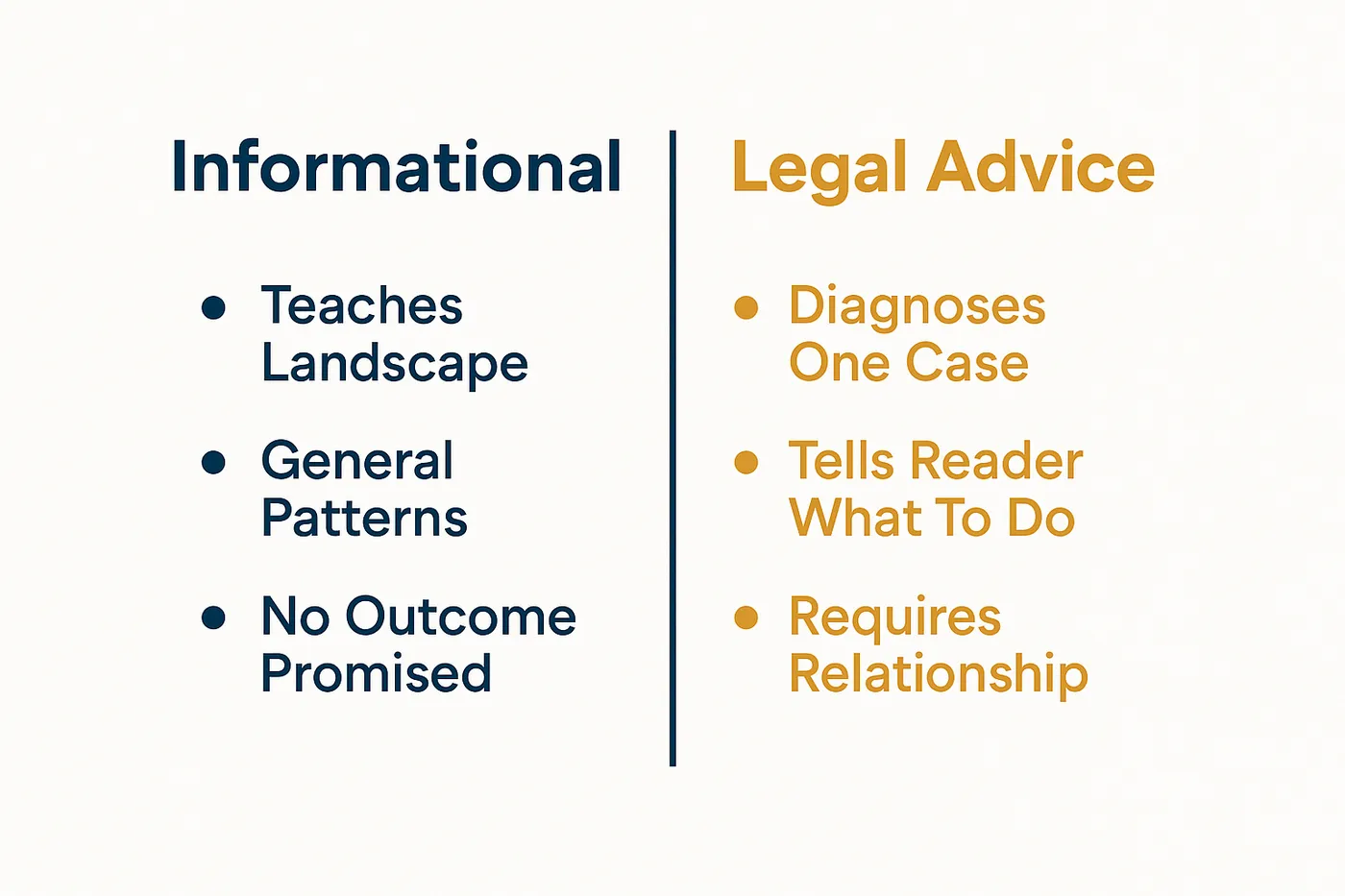
Most legal-professional books stay firmly on the informational side by design: teaching the landscape, explaining how a process generally unfolds, describing patterns across many matters, not diagnosing a reader’s individual situation. That’s a deliberate editorial choice, not an accident, and it’s also usually the more useful book anyway. A reader who is actually in the middle of a dispute needs a lawyer, not a chapter; a book’s real job is to help them recognize their situation, understand their options in general terms, and know when and how to get real help, including from you.
A standard disclaimer belongs in the front matter either way: a plain statement that the book is general information, not legal advice, that reading it doesn’t create an attorney-client relationship, and that readers with a specific matter should consult a licensed attorney in their own jurisdiction. That disclaimer should be reviewed by counsel (yours, or your firm’s) before the book goes to print, the same way you’d have a colleague review any other public-facing statement with your name on it.
What actually gets checked during compliance review?
This is where a lot of the anxiety about “will this get me in trouble” actually gets resolved, one specific pass at a time, rather than left as a vague worry hanging over the whole project.
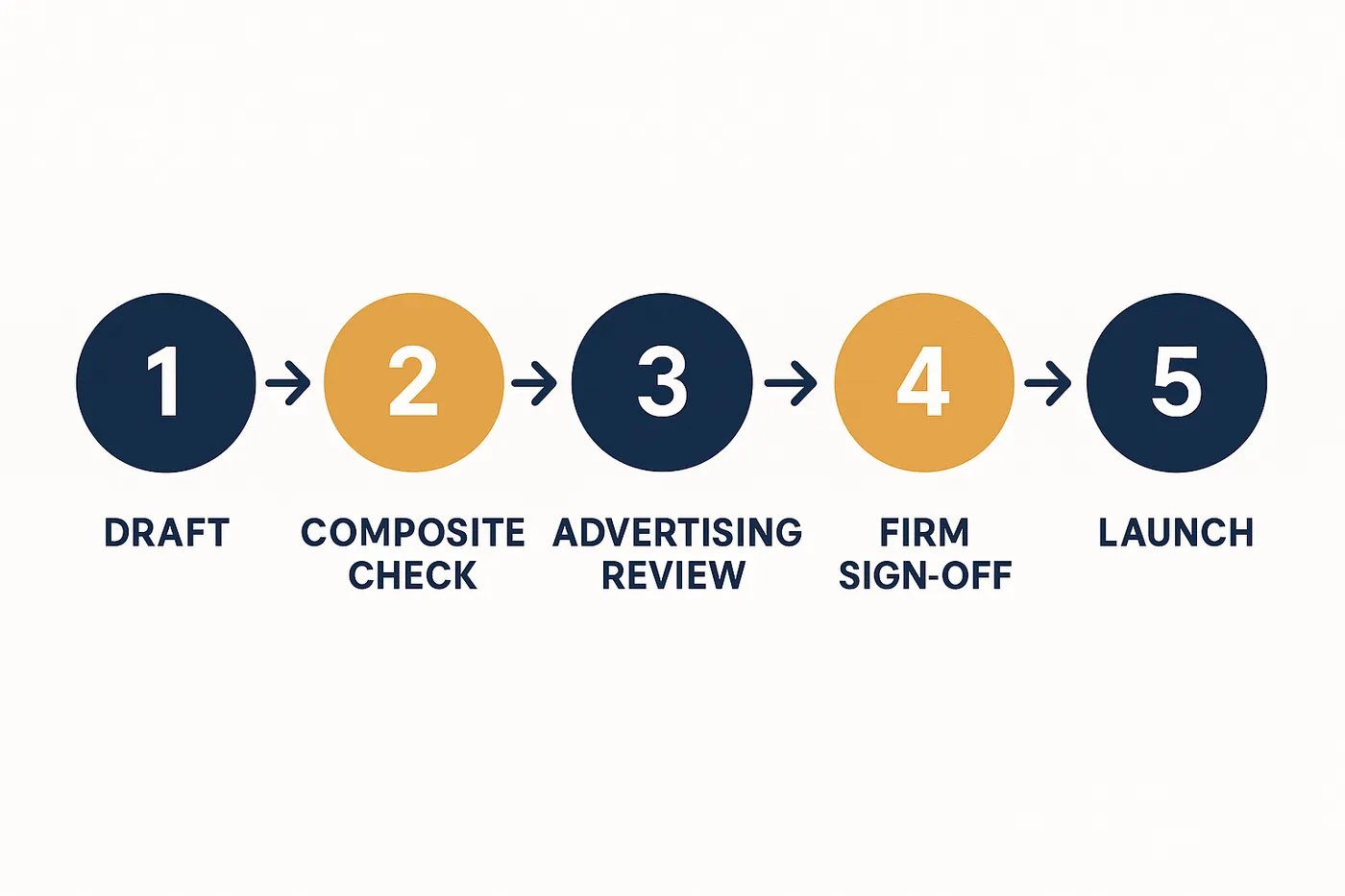
The draft comes first, written or extracted the normal way, without self-censoring every sentence for compliance while trying to also think clearly about the content. Trying to do both at once is how books never get finished. The composite check comes next: every client story, anecdote, or case reference gets reviewed specifically for identifiability, and anything that needs reshaping or explicit consent gets flagged here, before it’s locked into a chapter you’ve already grown attached to. The advertising review checks the manuscript’s language and the book’s marketing copy against the claims your jurisdiction’s rules actually restrict: outcome guarantees, specialization claims, comparative superiority claims. Firm sign-off, where applicable, happens before launch, not after a launch date is already public and hard to move. Launch itself includes the disclaimer language, the author bio, and the book description, all checked one more time as a set, since marketing copy is exactly where advertising-rule violations tend to slip in after the manuscript itself has already been cleared.
Running these as separate, named passes, in this order, is what turns “I hope this is fine” into “this has actually been checked,” which is a meaningfully different thing to be able to say if a question ever comes up later.
Two hypothetical attorneys, two different risk profiles
These aren’t real clients. They’re illustrations of how the same compliance questions land differently depending on practice area and role, since the actual risk profile of a legal book depends heavily on both.
Attorney A is a solo family law practitioner who has blogged about custody and divorce basics for years and wants to turn that material into a book aimed at parents heading into their first custody case. Her biggest exposure is confidentiality: years of blog posts and client conversations mean a lot of raw material that needs a careful composite pass before it becomes chapters, especially anything involving minors. Her advertising exposure is lower, since a parent-facing educational book in family law rarely reads as a specialization claim.
Attorney B is a partner at a mid-size firm writing a book aimed at other lawyers and referral sources, built around a framework he’s developed for a specific kind of complex litigation. His biggest exposure is different: firm sign-off, since the book effectively represents the firm’s expertise and brand, and advertising-style language, since a book positioned as “the definitive approach” to a practice area can read as a comparative claim depending on how it’s marketed. His confidentiality risk is lower, since the book leans on frameworks and patterns rather than detailed client narratives.
Same underlying compliance questions, genuinely different weight on each one, which is exactly why a real compliance review is a conversation about your specific book and role, not a checklist applied identically to everyone. Neither author’s project is riskier than the other in some absolute sense. They’re just risky in different places, and knowing which place matters most for your own book is what makes the review efficient instead of a blanket worry applied evenly across every page.
Questions to ask before you publish
Whether you’re working with us or building this alone, these are the questions worth having answered in writing before a manuscript goes anywhere near a printer.
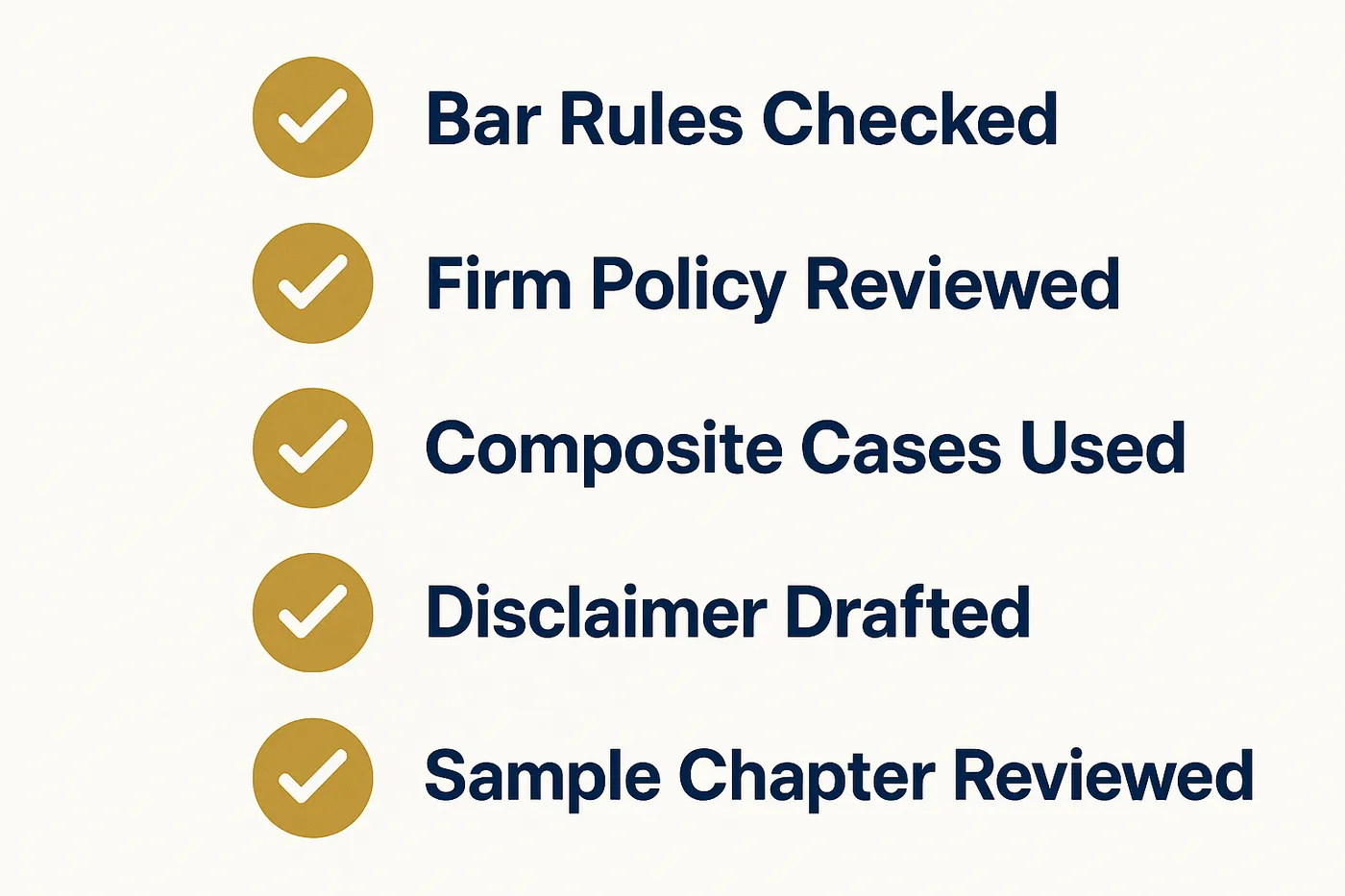
Have you actually read your bar’s advertising and solicitation rules, or asked your bar’s ethics hotline, rather than assuming a book is automatically exempt? Does your firm have an outside-publication or media policy, and have you cleared this specific project against it? Has every client story in the manuscript been confirmed as either a true composite or backed by written informed consent? Is there a disclaimer in the front matter, reviewed by counsel, stating this is general information and not legal advice? Has at least one sample chapter been reviewed by someone other than you, specifically for compliance, not just for prose quality? If any of these don’t have a clear yes yet, that’s useful information now, while it’s still cheap to fix, not after the book is printed.
What about government attorneys, judicial clerks, and in-house counsel?
The compliance picture gets an extra layer for anyone outside private practice. Government attorneys and judicial employees typically have additional restrictions on outside writing, speaking, and compensation that exist entirely separate from bar advertising rules, often tied to their specific agency’s ethics office or a judicial conduct code rather than the state bar. Judicial clerks in particular usually face strict limits on commenting on pending or even past matters connected to their chambers. In-house counsel sit in a different spot again: the confidentiality concern shifts from client matters to the employer’s own business information, trade secrets, and anything covered by the employer’s own confidentiality agreement, which is a contract question layered on top of the ethics-rule question.
None of this means these roles can’t write books. Plenty of former prosecutors, judges, and in-house counsel have. It means the sign-off chain is longer and involves a different set of people, usually an agency ethics office, a judicial conduct advisor, or an employer’s legal and compliance team, and that conversation needs to happen before the manuscript exists, not after.
Does the type of legal book change the compliance picture?
Somewhat, and it’s worth naming the categories separately because the risk shifts by type more than most authors expect going in.
- How-to and educational books for a lay audience (family law basics, small business formation, estate planning fundamentals) usually carry the lowest confidentiality risk, since they lean on general explanation rather than client narrative, but they need the tightest informational-versus-advice line, since a lay reader is the audience most likely to mistake a chapter for personal advice.
- Practice-building books aimed at referral sources or other lawyers carry lower confidentiality risk for similar reasons, but higher advertising-rule exposure, since they’re explicitly positioning the author’s expertise to a professional audience that includes potential referral relationships.
- Memoir-style books about a legal career carry the highest confidentiality exposure, since the entire premise is real cases and real experience, which makes the composite-and-consent pass the single most important stage of the whole project.
- Regulatory or subject-matter expertise books (a specific area of tax law, healthcare compliance, employment law) usually carry lower confidentiality risk, since the content is about the law itself rather than specific matters, but may need a technical accuracy review on top of the standard ethics passes, especially in a fast-changing regulatory area.
Being honest about which of these your book actually is, early, shapes which compliance passes matter most and saves time later.
What if you already blog, podcast, or post on social media?
Most attorneys who come to us with a book idea already have years of public commentary sitting somewhere: blog posts, LinkedIn articles, a podcast, CLE materials, conference talks. That existing material is often the fastest path to a manuscript, since it’s raw content you’ve already vetted once. It still needs the same compliance passes applied retroactively, not skipped because it’s already public.
Public commentary written years ago, under different bar guidance, a different firm’s policy, or before a specific matter concluded, can carry problems that weren’t visible when it was first posted. A case that was still active when you blogged about it may be resolved now, which changes what’s safe to say. A composite that felt anonymous in a blog post read by a few hundred people can read differently compiled into a book marketed more broadly. Treat existing material as a source to mine, not a finished draft to copy in unchanged. The same composite check, advertising review, and disclaimer pass described above apply to it exactly the way they’d apply to brand-new writing, since the medium changed even if the words didn’t.
Does this affect your malpractice insurance?
It’s worth a direct conversation with your malpractice (errors and omissions) carrier before launch, separate from the bar-compliance questions above. Some policies address media and publishing activity explicitly, some don’t mention it at all, and the answer genuinely varies by carrier and policy. This is a question for your insurance broker or carrier directly, not something a general article can answer for your specific policy.
What’s worth knowing going in is the shape of the question: carriers are typically less concerned with the fact that you wrote a book and more concerned with whether the book could be read as giving advice to a specific reader who then relies on it and is harmed, which loops back to the informational-versus-advice line covered above. A book that stays clearly informational, carries a reviewed disclaimer, and doesn’t diagnose individual situations is generally the safer shape from an insurance standpoint as well as an ethics standpoint, though your carrier’s own answer is the one that actually matters here, not a general assumption.
What happens if a complaint gets filed anyway?
Bar complaints get filed for all kinds of reasons, including ones that have nothing to do with whether you actually did anything wrong. A disgruntled former client, a competitor, or someone who misread a chapter can file a complaint regardless of how careful the underlying work was. That’s not a reason to avoid publishing. It’s a reason to have a documented compliance process behind the book before it goes to print.
Having a real record, who reviewed the composite pass, when the advertising review happened, what the disclaimer said, whether firm sign-off was obtained, turns “I think we were careful” into “here’s exactly what we checked and when.” That documentation doesn’t prevent a complaint from being filed. It’s the difference between responding to one with a clear paper trail and responding to one from memory, which matters a great deal if the question ever actually comes up.
What does the book actually do for a lawyer’s practice?
Referrals from clients who already trust your judgment before the first call, speaking invitations at bar association events and industry conferences, and a credibility marker that a website bio can’t match. Several of the attorneys who’ve come through our process describe the book as the thing that got them invited into rooms a cold pitch never would have opened.
In our intake data, compliance and confidentiality show up as the first question nearly every lawyer asks, ahead of cost and ahead of timeline. That’s the right instinct. A book that survives scrutiny is worth more than a book that got published fast and caused a headache later.
[TESTIMONIAL: pending permission: attorney author]
Is this the right time to write yours?
Readiness for a lawyer usually comes down to two things that have nothing to do with writing skill: whether you have a clear enough picture of your own client stories to know which ones need composite work, and whether your firm or agency situation is stable enough that a sign-off conversation is realistic right now. If you’re mid-transition between firms, in the middle of a sensitive active matter, or genuinely unsure whether your role allows outside publication at all, it’s worth resolving that question first, not because the book is a bad idea, but because starting the manuscript before you know the answer usually means rewriting sections later once you do.
If those two things are settled, or settled enough to start the conversation, the compliance work described above isn’t a reason to wait. It’s simply the work that happens alongside the writing, the same way it happens alongside any other public-facing statement you’d put your name on.
For the honest cost range behind a compliance-checked manuscript, see how much hybrid publishing costs. For the specific books lawyers write most often and the full profession breakdown, visit /for/lawyers, or book a strategy call to walk through your bar’s specific rules before you write a word.